
Apple Harvest, The Mystic’s Table Manners, Doing Good
A Sermon Preached by The Rev. Evan Graham Clendenin,
9th Sunday After Pentecost, 8/10/25,
Episcopal Church of the Holy Spirit, Vashon Island WA
Lectionary Texts: Isaiah 1:1, 10-20 Psalm 50:1-8, 23-24 Hebrews 11:1-3, 8-16 Luke 12:32-40

If you really want to learn to do good table manners, you should go see Henry Suso. If you want to learn good, go visit that mystic and saint, sit at his table, and see how he gave thanks. If you want to learn to do good, and to make an offering of thanks to God, simply sit down with Sweet Henry.
You would see how he prepared his food, and gave thanks, and welcome others at table. You’d see how he cut and enjoyed apples. And that might be a welcome little detail, given the overflowing apple harvest we can see this summer and fall. The trees in my neighborhood are loaded, and I can see the trees here on Vashon are cascading with apples and other fruit. And I know quite a few of you are orchardists.
So, Henry Suso was a Dominican brother, a variety of monk. Other Dominicans you may have heard of include Albert the Great, and his students, Thomas Aquinas and Meister Eckhart. Suso was a student of Eckhart. They were an order devoted especially to preaching and teaching. Henry Suso preached and taught along the Rhine river. Also, fun fact, his name Suso, is a variant of the word that means ‘Sweet’ in German. Suess or Siess. Heinrich Siesi. Sweet Henry.
He loved God, and felt things deeply, and he sought intense experiences and expressions of his desire for God, as he understood God at that time. Earlier in his life, as a young adult, he took this passion to rather gruesome medieval extremes. Long hours praying in uncomfortable positions, starving himself, sleeping little. He even got this great idea to sew tacks into his undershirt, in order, so he thought, to learn to suffer with Christ. His biographer didn’t think this was very good.
Henry also came to realize his extreme devotional contrivances were not good. Some of his study and devotion had been good, helped him to learn and mature, gain discipline, and guide his loving energies more truly to God and neighbor as himself. But it was time to out-grow some of these, and some, God had never wanted.

Siesi Heinrich flanked by two angels, bearing Holy Wisdom and Child within.
from Vie du bienheureux Suso, MS 2929 Strassbourg, Public Domain Via Wikimedia Commons.
And Henry began to realize God saying something like: reality, reality itself would offer him plenty of ways to join in Christ’s suffering. Rough treatment and danger on the road, false accusation and betrayal by friends, sickness, failed harvests. Government contrived famines and land seizures. Feudal pretenders seeking authoritarian breakthrough thru corruption, cruelty and perception manipulation. …You all know what I’m talking about!
You don’t need to contrive sufferings, the world will bring more than enough. It’s less about the external suffering, and more about your inner presence to bear more of the suffering you and others face. The question is whether you face these sufferings of others and yourself with an inner freedom that lets your be with love, and act out of love and courage, a persistent and focused desire to do good ‘for the long haul’, to offer the substance of your life, despite it all, in thanks to God. God changes us inside, in ‘the heart.’
And it’s in simple activities of daily living, like how we prepare and share food at table, that a heart transformed by God is demonstrated. Henry loved apples, but earlier in life he would deny himself apples because he thought his enjoyment of the fruit was a sinful desire. Around that time, the apple harvest failed in the region. And something shifted in him, in his regard toward his desire for apples, in how he could see that God met him in his desires and his own being and in others. He prayed to God saying, ‘God if you want me to enjoy apples, please provide enough for all the community to enjoy them too.’
And wouldn’t you know, not much later, a noble stranger came by to eat with the brothers, and left them a nice big silver coin, enough to buy a whole crop of apples for the brothers to enjoy. So Henry enjoyed apples as a gift of God. He would take an apple and slice it into four pieces. Three he would peel, to remind himself of the holy trinity, one he would leave unpeeled, in appreciation of the fact that children at the time ate their apples unpeeled, and we might become as little children. (I know the peel is the most healthy part, we could tell him that now.) And he greeted and welcomed God at every meal, offering the Holy Wisdom food and drink, attending to them in gentleness and welcome.
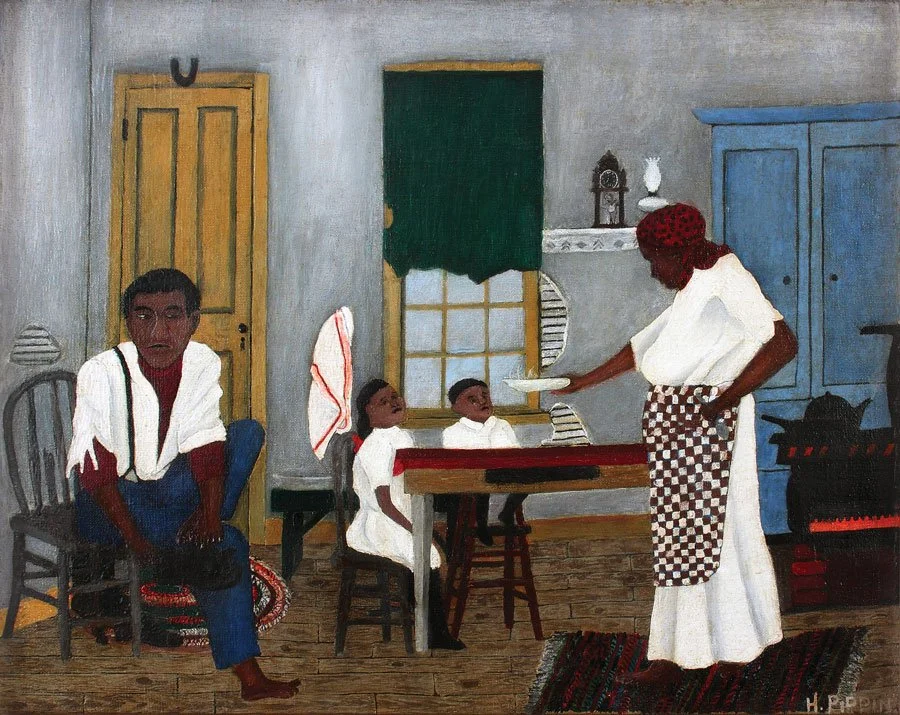
Sunday Morning Breakfast, Horace Pippin, 1943, Public Domain via Wikimedia Commons
There come moments when we what we had thought we needed to do to get near God falls apart and flakes away. A devotion, a study, an ideal, some practice, habit, or ritual, some belief taught or caught by life, upbringing, education, the pressures of life, or one’s own false self pursuits…you come to find these are not what God wants. Isaiah and the Psalmist speak to this…
“I am weary of your offerings”
“Do you think I actually like the blood of goats?”
In such moments you may discover that the God of your understanding, your inner picture of the holy one, is undergoing subtle, and not so subtle, changes. Such movements and changes in our faith transform us, make our worship and prayer more truly a sacrifice that is ‘reasonable, holy and living’, - a practice of everyday gratitude and simple, persistent doing good.
And God gives us a Holy Spirit assist, a silver coin when we need it. The master will come and serve them, us, at his table, says Luke today. And we receive again the chance to learn to do good, and to give thanks to God, in worship, and prayer, and in all of life as we live it a day at a time.

Stages of Compassion
I (John) preached a sermon this past Sunday at Plum Creek Presbyterian Church on Lament and Compassion. The church is located very near where the Wild Indigo Guild (Center Guild) will take place starting this fall. It’s a beautiful area near Boyce Park and farms still existing in the suburbs.
I was asked to post my notes/manuscript by one of the parishioners. Here it is.
The Judgment of the Nations - Matthew 25
31 “When the Son of Man comes in his glory and all the angels with him, then he will sit on the throne of his glory. 32 All the nations will be gathered before him, and he will separate people one from another as a shepherd separates the sheep from the goats, 33 and he will put the sheep at his right hand and the goats at the left. 34 Then the king will say to those at his right hand, ‘Come, you who are blessed by my Father, inherit the kingdom prepared for you from the foundation of the world, 35 for I was hungry and you gave me food, I was thirsty and you gave me something to drink, I was a stranger and you welcomed me, 36 I was naked and you gave me clothing, I was sick and you took care of me, I was in prison and you visited me.’ 37 Then the righteous will answer him, ‘Lord, when was it that we saw you hungry and gave you food or thirsty and gave you something to drink? 38 And when was it that we saw you a stranger and welcomed you or naked and gave you clothing? 39 And when was it that we saw you sick or in prison and visited you?’ 40 And the king will answer them, ‘Truly I tell you, just as you did it to one of the least of these brothers and sisters of mine, you did it to me.’ 41 Then he will say to those at his left hand, ‘You who are accursed, depart from me into the eternal fire prepared for the devil and his angels, 42 for I was hungry and you gave me no food, I was thirsty and you gave me nothing to drink, 43 I was a stranger and you did not welcome me, naked and you did not give me clothing, sick and in prison and you did not visit me.’ 44 Then they also will answer, ‘Lord, when was it that we saw you hungry or thirsty or a stranger or naked or sick or in prison and did not take care of you?’ 45 Then he will answer them, ‘Truly I tell you, just as you did not do it to one of the least of these, you did not do it to me.’ 46 And these will go away into eternal punishment but the righteous into eternal life.”
I’m reading a book with a few folks right now called “The Tears of Things,” by Richard Rohr. I bet you’ve heard that name before, or you’ve read some of his books or listened to his podcasts. In chapter 7 Fr. Richard opens up the book of Lamentations, a prophetic book of the Hebrew Bible, not one that we read very often in church. We don’t like to lament, do we. Our lectionary skips right over Lamentations except for the one hopeful section in the middle of the book. There are many places in the scriptures where God’s people lament, mourn, feel the deep sadness of creation’s suffering.
Jesus’ words in our Matthew passage remind us just how important compassion is to salvation. There is a definite link between lamentation and compassion. Jesus makes compassion the thing that opens the gates of heaven! Jesus suggests that the compassion that we have on “The least of these” opens our eyes to the Christ present within each and every suffering person.
What is compassion? First of all, passion is the feeling of emotion. When we feel passionate about something or someone its an overflowing of emotion… it’s about feeling… passion is any emotion felt at its fullest. The prefix “com” is related to the words community or comfort… it implies “with-ness”. Compassion is feeling of emotion WITH another. Compassion is feeling the pain, sadness, love… the emotional extremes of another.
Three Stages toward compassion.
The first stage is where we find the people who think they haven’t seen Jesus hungry, naked and suffering. In this stage we have no compassion, or we bury our compassion so we don’t have to feel anything or do anything. This is the stage where we victim blame, we come up with reasons that someone deserves to be hungry, deserves to be suffering. In this stage we cannot see Christ in the suffering of humanity. We blame the people of Gaza for the actions of Hamas, allowing us to ignore the suffering of babies, children and innocent people. We blame the poor for not working hard enough. We blame the sick for not taking care of their health. These people that never see Jesus in the eyes of another person, in the eyes of all God’s people, are those on Jesus’ left hand side, those who do not know him, cannot recognize him. There are so many reason we get stuck in the state of denial.
But, compassion will rise up in each of us. Compassion is Christ’s love welling up in our hearts, unifying us with others and with Christ.
This is when the the second stage of compassion arrises from the compassion of Jesus within us.
The second stage is when we see suffering and we want to take action to help. Suffering is seen as a problem and we believe we can solve that problem, or at least put our two cents toward solving the problem. Don’t just stand there… Do something stage! Here we begin the move from complacency and/or ignorance toward understanding and compassion. Jesus says, I was hungry and you gave me something to eat. In this second stage we see the suffering of other sand we desire to alleviate that suffering. We see Jesus in the eyes of humanity.
But, in our beginning to see and feel the suffering of the world many of us quickly try to solve the problems of the world, or at least do what we think is our part to solve the problems of the world. Don’t get me wrong, we should all be working to alleviate suffering in the world! In this stage we feed the hungry, we cloth the naked. But, do we sit with the lonely and listen? Do we visit the imprisoned and fully understand their suffering? Often not. This stage of compassionate action in the world leads to what I believe is the highest stage of compassion.
The third stage might be represented by flipping the Don’t just stand there phrase upside down… Don’t just Do Something… Stand there! There are a lot of people, most I’d say, who prefer to do something that makes them feel like they fixed a problem, so that they don’t have to feel the suffering of the world. But, Jesus includes two actions that are really hard for those of us who like to “do” or “give” and then walk away. Jesus says, “I was sick and you took care of me, I was in prison and you visited me.’”
Have you ever cared for someone who was sick? Have you ever cared for someone who was dying? Some of us care for our parents when they near the end. But, even that is rare these days. While nursing homes can be a great tool in caring for the elderly, they can also become place of abandonment of our elders. I think many elderly people in nursing homes feel like they’re imprisoned.
My dad worked for a large church in the north hills of PIttsburgh. He tells a story of the lead pastor asking who was available to go to the local nursing home. None of the pastors or staff wanted to go, but they did make it a monthly practice. My dad decided he go and over time it became of the most meaningful parts of his ministry in the church. They would lead a short service with some songs, but mostly he would sit with people, hold their hands and listen to their stories. My dad, not an ordained pastor, became the pastor those in the home. He saw Jesus in their eyes, and likewise they saw Jesus in his.
I have to admit, I am a problem solver. I thrive in situations where I can identify a problem and find solutions. As some of you may know, I’m a permaculture designer. In permaculture we looks to create ecological landscapes that support biodiversity while also producing food and fiber. Permaculture is about getting all that we need from nature while at the same time seeing nature restored to health. Nature is suffering, just as human beings are suffering in our world today. I love permaculture because we use the principles and practices to identify problems in nature and solve them, flipping the problem into the solution is one of the attempts in permaculture. Let me give an example: One of the gardens at our farm is on a hillside. When we first started to try to grow vegetables on that plot of land we realized a big problem, when it rained hard water was eroding the good soil to the bottom of the hill. We dug swales to catch and store the water deep in the soil, slowing it down and sinking it in. The excess water became a solution to our water needs, no longer a problem. I love those sorts of problems! We come out the other side better off than where we started!
But, over the past few years I’ve learned many lessons about problems I cannot solve. I see suffering not only in humanity but in all of creation… suffering that is caused by human greed. Climate change and deforestation are causing massive changes to local ecological systems. And we know that climate change is causing immense human suffering, unthinkable tragedies. We remember the children who died in Texas while at summer camp. We remember the large scale destruction in the North Carolina last fall. We remember the mega-fires that wiped out 25% of ancient giant sequoias in 2022 and 2021.
Our compassion leads to solidarity… with-ness… no matter the outcome of our problem solving.
I’m continuing to try to solve problems, but our love of people and our love of creation leads us to compassion and solidarity that does not hinge on the effectiveness of our problem solving.
Our passage today is quite remarkable. These are Jesus’ words making it very clear how it is that we receive eternal life - and it has nothing to do with praying the “sinner’s prayer,” does it? Instead, according to Jesus in Matthew 25, compassion is what demonstrates our belonging in God’s eternity.
The suffering of humanity IS the suffering of Christ. The Christ is present in all of creation, The Christ is present with all of who suffer, The Christ becomes present to us through all of creation. When we begin the journey of lamentation, of allowing ourselves to know the pain and suffering of the world, we begin to see that Christ is present to us through that suffering. This is a hard teaching, I know. But this is the full circle that we enter into when we feel compassion which leads us to action. Our action in the world just might lead us to real connection to Christ through our connection to one another.
Native Plants Restored!

Native blueberries are a great addition to many church gardens.
This spring, and now summer, has been a time of planting for Wild Indigo Guild! A few months ago Eastminster Presbyterian Church contacted us asking if we would create a full landscape redesign for their urban property. This church is just down the hill from where I live, a block from where I went to seminary, you can see Garfield Community Farm’s water tower just up the hill when you’re standing on their property. The staff didn’t want to have us lead the educational and spiritual formation aspects of our program, just design and implement a plan to transform the grounds from a sparse and boring yard to a thriving landscape of native plants.

The Eastminster Church Design
This is huge! It feels like the tide is turning in some churches. People and leadership are realizing their congregations get excited knowing their land is growing food, supporting wildlife and creating beauty for the neighborhood!
So far Wild Indigo Guild has planted 250 native perennial plants in both full sun and shady areas of the property. We’ve planted, I think, 25 small trees and shrubs, native and berry producing. Some of the plants we’re putting in are: Red Chokecherry, serviceberry, fragrant sumac, blueberry, red currant, rose milkweed, aromatic aster, bergamot, slender mountain mint, blazing star, purple coneflower, orange coneflower and much more.

Fragrant Sumac, a native shrub, ready to be planted.
The large front yard of the church wasn’t really used for anything, except for their annual live nativity. We’re saving plenty of space for that. But now, the surrounding area will an inviting garden with trails and seating. Moths, butterflies, pollinators, hummingbirds and migrating song birds will all have a space to eat, nest and perform their myriad ecological services. The garden will also become a space of abundant berry production from the dozens of edible berry producing shrubs. I can already taste the sweet serviceberries and tart currants!
We continue to need your help to do this work! Please consider a donation!
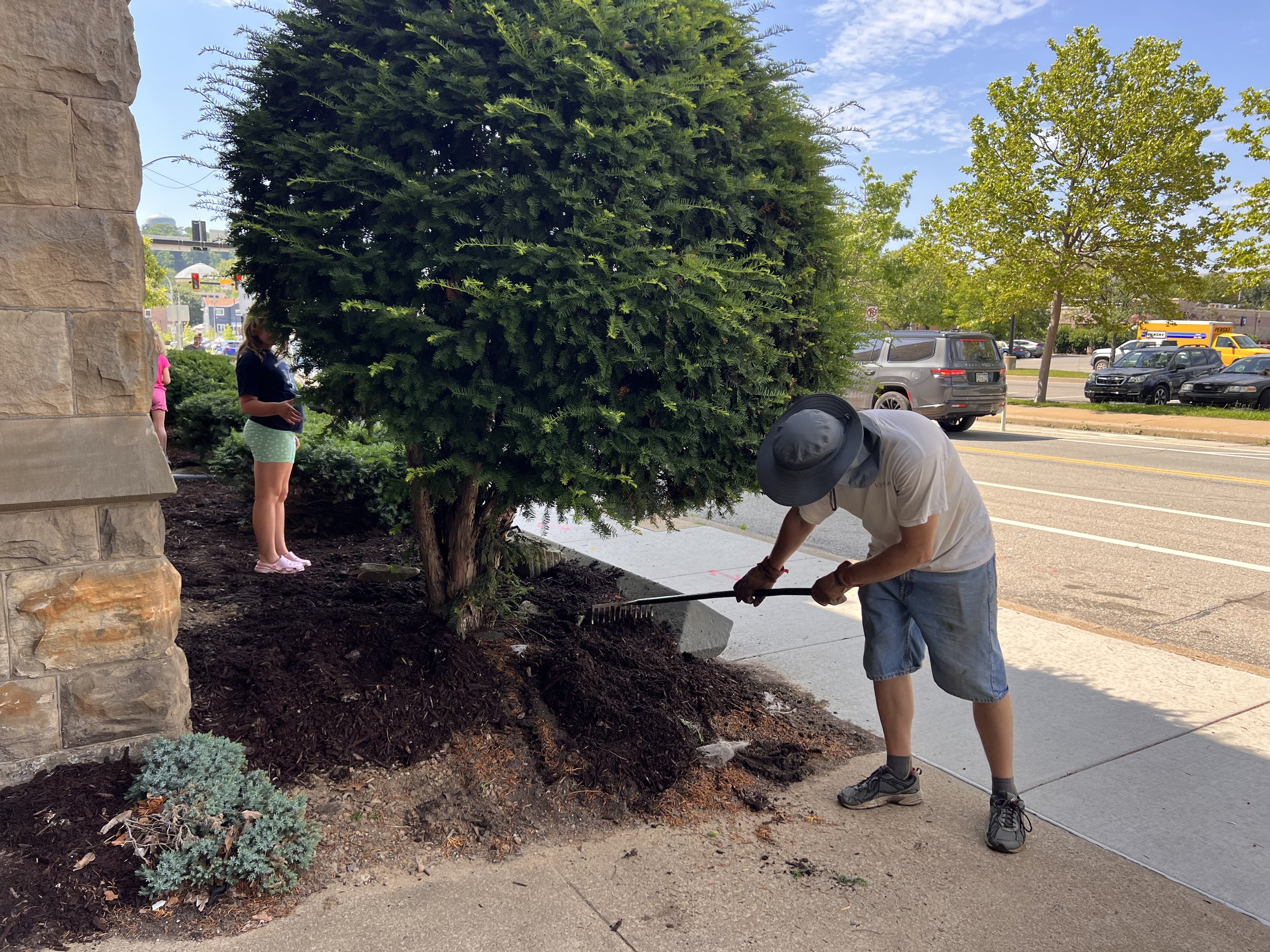
WIG volunteer and board member, Jake K., mulching under and existing shrub.