Summer of Action
We’ve been busy this summer putting our plans into action!
We’ve been quiet on the website and blog for a few months, not because we haven’t had anything to write, but because we’ve been so busy actually doing the work we’ve planned for so long! Here are a few snippets of our work in May, June and July.
Our Second Guild: Westminster Presbyterian Church
Back in April we began a “guild” at Westminster Presbyterian Church of Greensburg. Guilds are small groups within larger congregations who learn, pray and work together to come to a greater appreciation of God in nature and our call from God to care for the earth . Together we worked through the eight weeks of the first phase of the Wild Indigo Guild program. It was so wonderful to get to know a group of people and learn with them about God’s call to care for the earth and care for our communities. Together the group of about 10 people began to discern some specific ideas for their multi acre site as we realized the potential for food production and ecological restoration. On our last day of the first phase we planted a swamp white oak at the church, a tree that I grew from seed. It was a powerful experience to get this little tree into the soil of its new landscape. Evan and I are excited to continue to work with Westminster to develop more concrete plans for action in Phase 2 of our guild program.
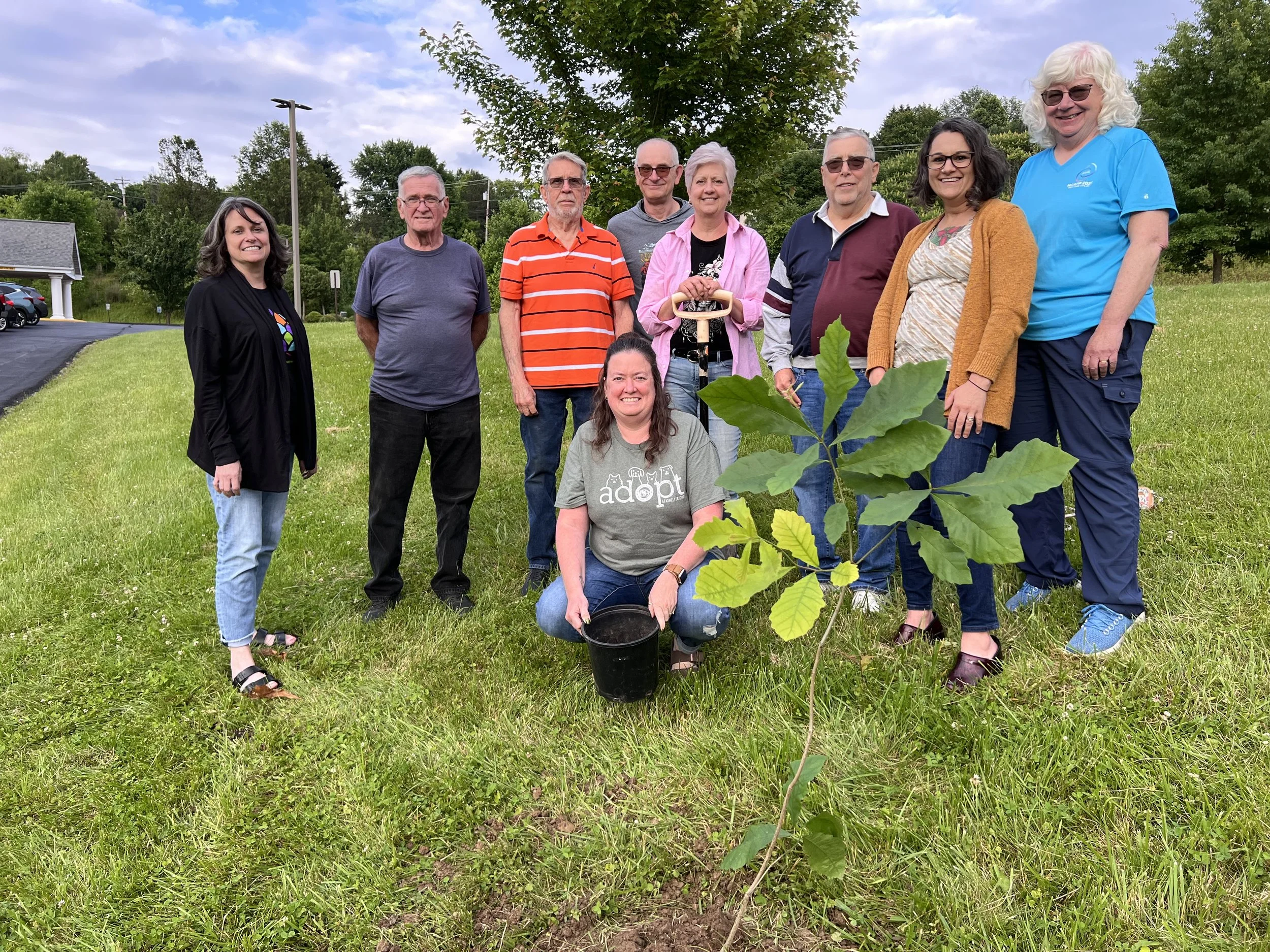
Our Guild from Westminster Pres and their new Swamp White Oak.
Summer Institute of Pittsburgh Seminary
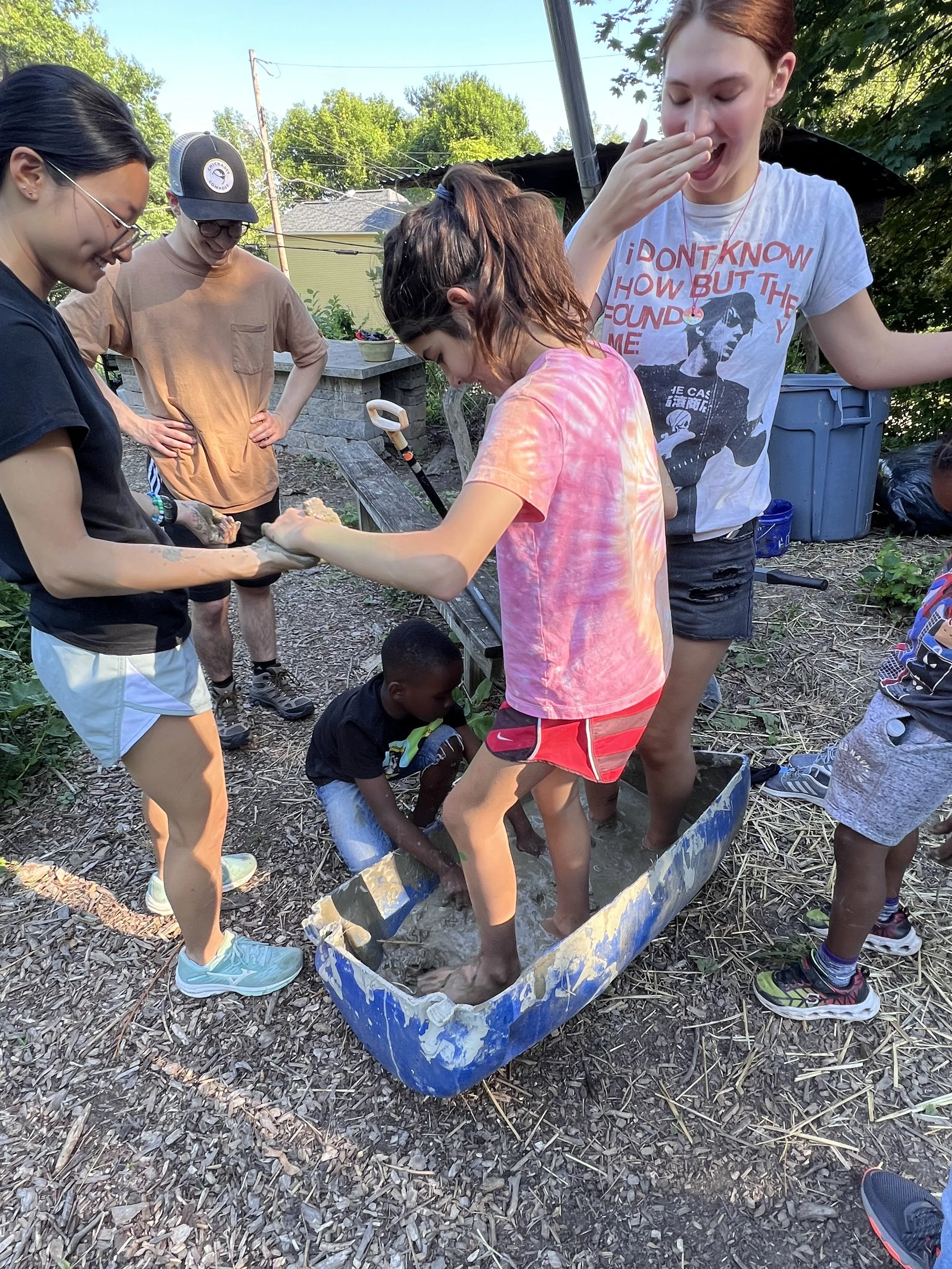
Also in June we began a six week program with Pittsburgh Theological Seminary’s Summer Institute for college students. The focus of the program was on eco-theology and social justice, specifically climate and environmental justice. Together we worked at Garfield Community Farm, dove into permaculture design and even built a portion of a cordwood and cob wall! These students were amazing and gave me hope that the young generation of adults are not giving up but leading the way toward a sustainable future. We’re so grateful for this opportunity to hone our teaching skills with young adults and to work with amazing workshop leaders from around the country.
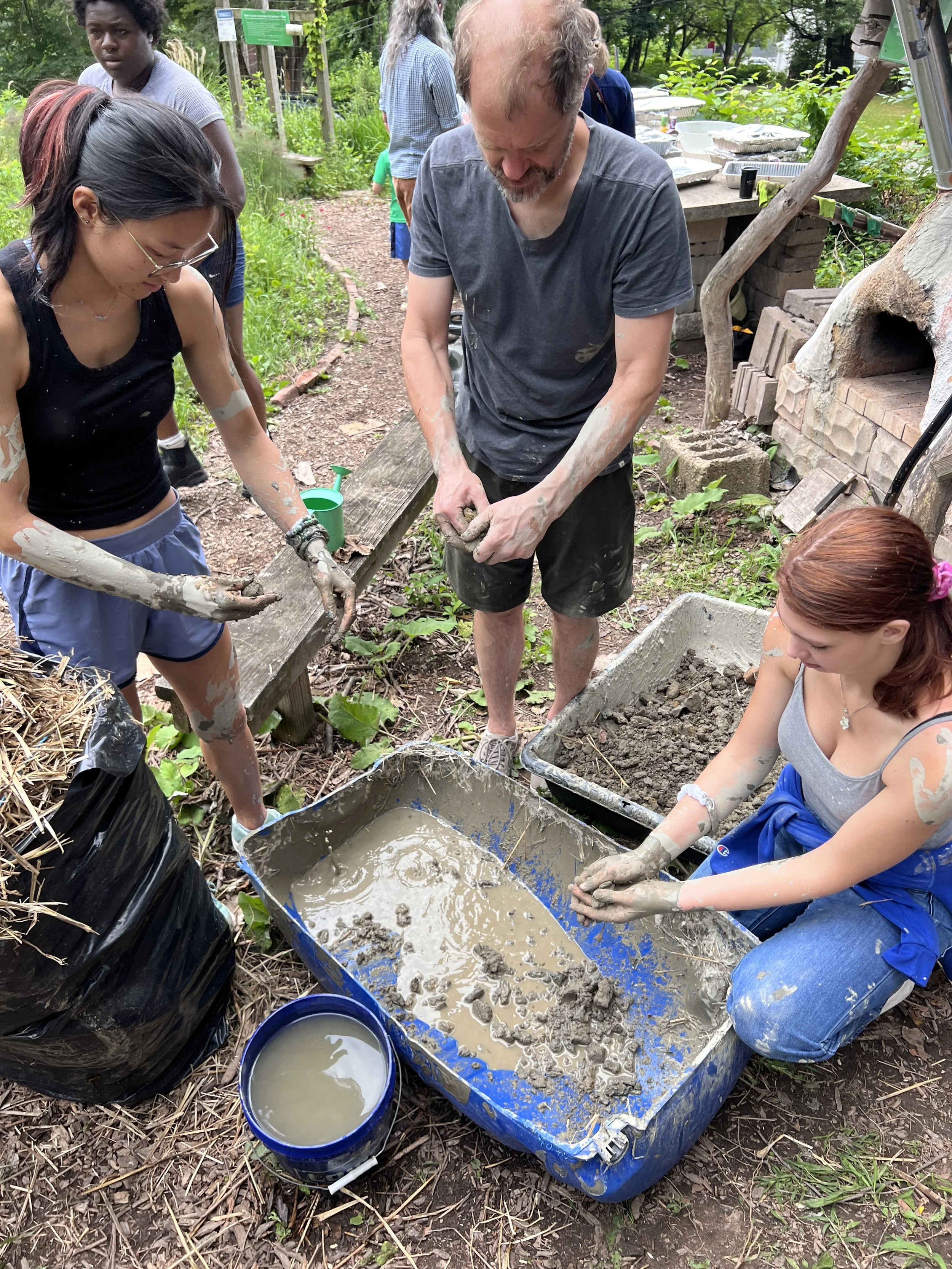
Working with clay, sand and straw to make cob, an ancient and effective natural building material.
East End Youth Ministry
Also in June, Evan and I began work with East End Youth Ministry and our friend Alex Ruzanic. This opportunity has already been a lot of fun and a great learning experience for us both. We’re learning how to make our curriculum adapt for students in sixth through twelfth grade - not always an easy task! We were delighted when we showed up at Beulah Presbyterian Church, the home of EEYM, and found a turkey hanging out by the entrance! We quickly learned that the turkey had already been named by the campers and had become a beloved mascot! Jeffery the turkey has turned into a great learning tool for us as we’ve worked to understand how the myriad of living creatures in any ecosystem support one another and provide for each other’s needs. This drawing was our “niche analysis” for Jeffery and his many neighbors.
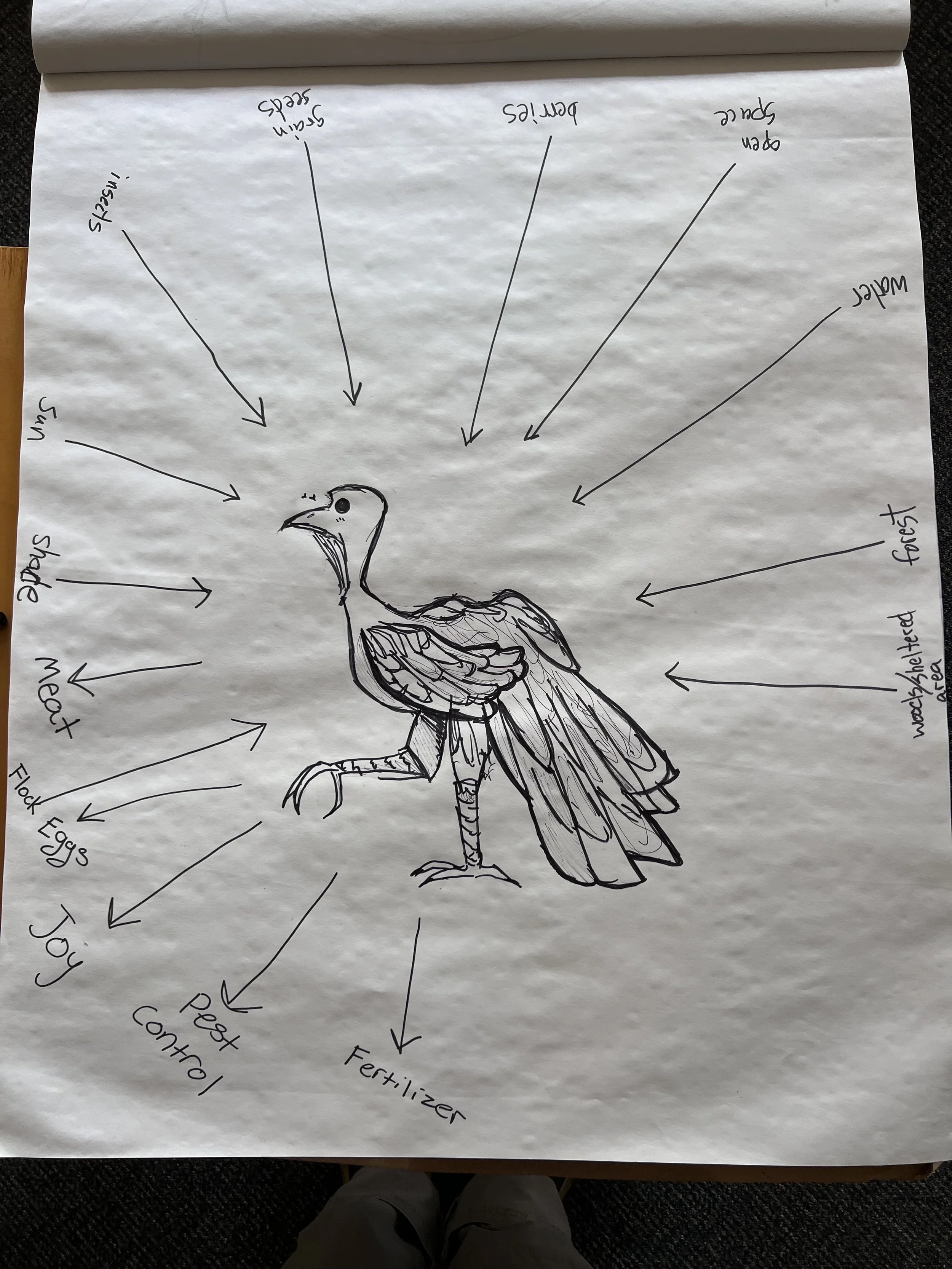
Jeffery the turkey! Drawn by a student of EEYM. Together we figured out the ecological and farm niche for Jeffery.
Yesterday Evan and I met to discuss the future and our plans to expand our work. We so believe that now is the time for people of faith to connect with God through nature and develop realistic plan for ecological restoration and climate action. We’re ever grateful to The Open Door Church for helping us launch this important work. We’re also grateful to those who have already donated to make this work happen. Our world is heating rapidly now and its our job, as followers of Jesus, to do what we can to show our communities what it can look like to care for land, people and our more-than-human neighbors. This fall we’ll be hosting a few fundraising opportunities, at least one book group and at least two more guilds. We hope you can join us soon!
And, please consider a donation to help us make this work as affordable as possible for any group and church.
Dancing in the Wind
During week two of our Guild at Westminster Presbyterian Church Caryl shared this poem with us that she wrote during time in her “sit-spot.”
The tall, majestic oaks and poplars sway to the rhythm of the wind.
Some like the pear jump all in like the hokey-pokey.
Others twitter their leaves keeping time to the music.
Some pairs are intertwined, swaying like Fred and Ginger.
As the music of the breeze gets louder, the branches sway ‘til you wonder why they don’t break.
But they are built for this. Bending, dancing, gracefully touching the sky.
There is a peace in the dance. A soothing of the soul.
Tilted skyward the dance is mesmerizing. It fills the heart.
The trees need the wind to scatter seeds, to clear out dead branches and leaves.
Does the wind need the trees?
They certainly change the wind. Bouncing around and slowing down.
But there would be wind without the trees.
Caryl Fish, April 2024
Garfield Community Farm’s Land Acknowledgment
Pittsburgh’s hills and river basins have always been the land of ecological and cultural convergence. Here we find ecological systems meeting from the mountains in the east, the grasslands to our west and northern forests and lakes in the north and the broad leaf forest to our south. It has also been a land where people converge.
Garfield Community Farm exists on three city blocks where thirty homes once stood. A neighborhood of working class Irish, English and Italian immigrants gardened these spaces, tended a community orchard and lived in homes on this land. Later African immigrants from the Southern states made the Garfield hill their new home bringing new foods and culture on their journey north. But this land, these hills and river basins that we call Western Pennsylvania were a land of converging cultures far earlier than the 1900’s.
Pittsburgh’s rolling hills, hundreds of streams and rivers running toward the convergence of the great three rivers, seems to have always been a land of cultural convergence. For thousands of years our land was a shared area of converging indigenous people. Few tribes or nations call these hills their ancestral home, but many cultures met on these hills because of these three rivers.
About 12,000 B.C. at the Meadowcroft Rockshelter and Historic Village in Washington County some of the earliest known people in our part of the country lived and called the hills of western PA home. The Osage people call the Ohio River basin their origin as a people, later migrating west and south through the Mississippi River Basin. Later the Adena people arrived, then the Hopewell and Monongahela. During colonial invasion in the east nations again converged with the rivers finding a land of plenty. The Susquehannock and The Delaware peoples came from eastern Pennsylvania, Shawnees arrived from the south and Iroquoian people migrated from New York state. Because the area wasn’t the ancestral homeland for many of these nations, their cultures often mixed like the Allegheny and Monongahela Rivers.
For a few decades the three acres that are now Garfield Community Farm, sat vacant, houses gone and foundations of homes filled in with rubble. Today Garfield Community Farm is a place where people meet, mix with one another and natural systems and leave these acres of land better for it. Our land was the shared land of many peoples before it became what it is today. We can only strive to honor the indigenous people and all those who lived here before us by caring for our land well, using it to care for one another well, and to leave this land for future generations to tend and reap its bounty. Today, we at Garfield Community Farm strive to continue to honor indigenous first nations by hearing their stories, learning how they live today and by understanding the continued quest for land and food sovereignty in 21st century. We seek to honor our current neighbors who have rich family histories, connections to land, and much to teach us in our quest to care for the earth, care for one another and do it with equity and justice.