The Forgotten Plants of Eco Gardening
by John Creasy
In my last post I outlined the most commonly listed categories that permaculturists use when understanding the roll a certain plant plays in a community of plants. We call this study of plants “niche analysis.” The categories that I listed are primary producer, pollinator, beneficial insect attractor, nitrogen fixer, pest confuser, dynamic accumulator, mulch plants and ground covers. Go back and read my previous post from last Friday to learn more about these categories.
There’s one category that is left out of our niche analysis. It’s a really important category from the perspective of ecological restoration and biodiversity but it may seem unimportant or counter-productive for food production. In permaculture we’re committed to both restoring ecological systems and growing the food we need. Because of this twofold commitment we can’t ignore this category of plants that primarily supports biodiversity, though I’ll also show how these plants support our food production too. While some plants support pollinator populations and other plants attract predatory insects there’s another category of native plants that provide the vegetative food at the base of the ecosystem food web. For now I’m using Douglas Tallamy’s term, “keystone plants.”
I recently heard Tallamy talk about the problem of planting only pollinator plants. Its great to support pollinators, and in permaculture this helps us get more fruits from our trees, shrubs and garden plants. But pollinators are not the only insects that need support in our degraded ecosystems. Some insects need certain plants so they can eat those plants. The relationship between milkweed and monarch butterflies is a great example of a plant and butterfly relationship, but there are many hundreds of species of moths and butterflies that all need the right plants.
Our guilds (the plant communities that we create) are often designed to repel the insects that eat plant leaves, and yet, from an ecological perspective, these insects, especially moths and butterflies, are crucial to the food chain. Lepidoptera (moths and butterflies) eat leaves and then are eaten themselves by birds, larger insects, bats and many other creatures. Moths and butterflies and the plants that they eat are the foundation of our food web. The consumption of green plants by moths and butterflies move the energy in those plants up the food chain and into the air via birds and bats.
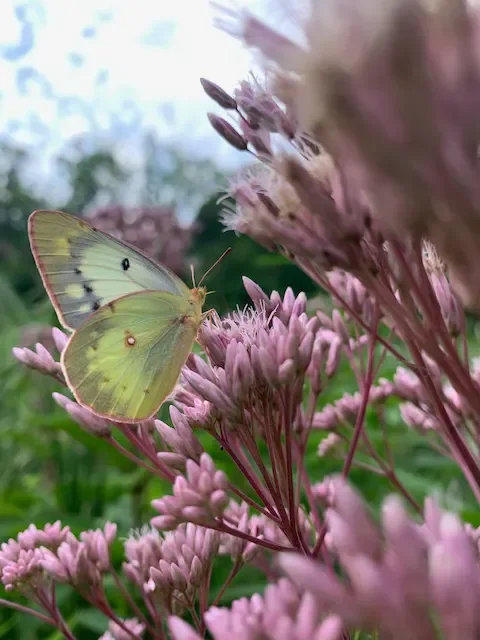
The Clouded Sulfur on Joe Pye Weed near my home.
So, how do we grow lots of food and support Lepidoptera species? If we do this are we just inviting pests into our gardens? Or are there benefits to having a diversity of moths and butterflies in our gardens and among our fruit trees? For me, there is no question that the right thing to do in our day is plant things that will feed moths and butterflies. Biodiversity is decreasing at alarming rates, especially among the Lepidoptera species. According to a research article in Science:
“Between 2000 and 2020, total butterfly abundance fell by 22% across the 554 recorded species. Species-level declines were widespread, with 13 times as many species declining as increasing.”1
That’s a decline across the board, affecting almost all species of moths and butterflies. And we see it, there are fewer and fewer fluttering wings around us each summer and therefore fewer bird species.
Thanks for reading! This post is public so feel free to share it.
Pearl Crescent Butterfly. While the adults use the pollen from many native plants the eggs are laid on plants in the aster family and the larva eat the aster leaves.
The good news? As Bill Mollison, the co-founder of the modern permaculture movement, would say… “the problems of the world are increasingly complex but the solutions remain embarrassingly simple.” He was right. I could research and write all day about the complexities of both ecosystems and human destruction of those complex ecosystems but I think I can explain the solution in just a few sentences. Plant native plants to create a balanced ecosystem. Ok, it just took one sentence.
There are actually huge benefits to attracting native Lepidoptera to your food forest, your orchard and your garden. We need not worry that we’re attracting insects that will eat our food crops, we’ve already done that by planting the food crops themselves! Cabbage worms eat cabbage, apple maggots eat apples and so on. What we’re not doing is supporting the beneficial insects that eat those pests if we’re not supporting a balanced ecosystem that supports other species very similar to the pest species. For instance, we plant “beneficial insect attracting” plants around our apple trees at the farm. But, those beneficial insects that parasitize moth larva need moth larva every year and in high numbers. When the pest species show up we want the populations of the beneficial parasitic wasps to be healthy and ready to pounce. We create this kind of dynamic ecosystem by attracting all sorts of native moths and butterflies into our permaculture landscapes. Then, when the pests show up there’s already an ecosystem ready to keep them in check. At least that’s our goal in permaculture design, creating managed and balanced ecosystems.
When our landscapes are diverse with native flora we can rest assured that balance of beneficial and “pest” species will be kept in check. We should also remember that apples, pears and peaches aren’t native trees. The moths that attack them are not native species. The plants that support native Lepidoptera are not plants that attract the invasive pests that consume our beloved fruit trees!
At Garfield Community Farm we’ve planted two native plants that have both begun supporting native moths and butterflies. The first are our fifteen or so pawpaw trees spread throughout the food forest. We’re now sharing our tree with the very rare Zebra Swallowtail butterfly! That means these butterflies are eating some of the leaves of our trees and we’re more than ok with that. Another species that we've planted a lot of for its ability to fix nitrogen is Amorpha fruiticosa, aka wild indigo shrub or river locust. These shrubs also host the larva of California & southern dogfaces, Silver-spotted Skipper (Epargyreus clarus), Gray hairstreak and Hoary edge skipper. Just last week my co-worker, AJ, found our first Gray hairstreak fluttering around the farm.
According to Douglas Tallamy there are “keystone species” in every eco-region. These are the plants that support the high diversity of native Lepidoptera. According to the National Wildlife Federation “The research of entomologist, Dr. Doug Tallamy, and his team at the University of Delaware have identified 14% of native plants (the keystones) support 90% of butterfly and moth lepidoptera species.”2 In the north eastern United States some of the species of plants we should plant, or just encourage, are some of the easiest plants to grow! They include:
All species of native goldenrod, Solidago
All species of native strawberry, Fragaria (this was very surprising for me to find!)
Native sunflowers, Helianthus
Joe Pye Weed, Eupatorium (a beautiful native plant that is easy to grow).
The above plants are the top four keystone species according to the National Wildlife Federation. I called this article “The Forgotten Plants,” but these four species aren’t really forgotten at all, they’re just not used enough or appreciated for their amazing ability to support ecosystem health. There are many plants that support lepidoptera species, so plant a diversity, but don’t forget goldenrod. According to Tallamy, goldenrods support 126 different species! The next best native plants are the strawberries which support 77. Beyond these four herbaceous perennials there are certain native trees that also support a much higher diversity of munching moth and butterfly larva. The best tree to plant is unquestionable… oak.
Oak trees support over 500 species of Lepidoptera! So even better than planting your keystone species in the herbaceous layer of your food forest maybe plant an oak tree if you have the space. There are over a dozen native oak species in the north east, each species supports a huge variety of moths.
Rapid butterfly declines across the United States during the 21st century. https://www.science.org/doi/10.1126/science.adp4671
National Wildlife Federation. https://www.nwf.org/Native-Plant-Habitats/Plant-Native/Why-Native/Keystone-Plants-by-Ecoregion