How to Make Room for Growth and Dwelling
John came to Washington this week for a Presbyterian church training, followed by a hike in the Hoh rainforest and Olympic mountains. Downtown Tacoma, and the sublime sights along the Pacific coast.
This trip also gave us the chance to visit, work on some things, and also see some humbler sights closer to my home in Olympia. Like mountains and glaciers, resoundingly impressive, living.
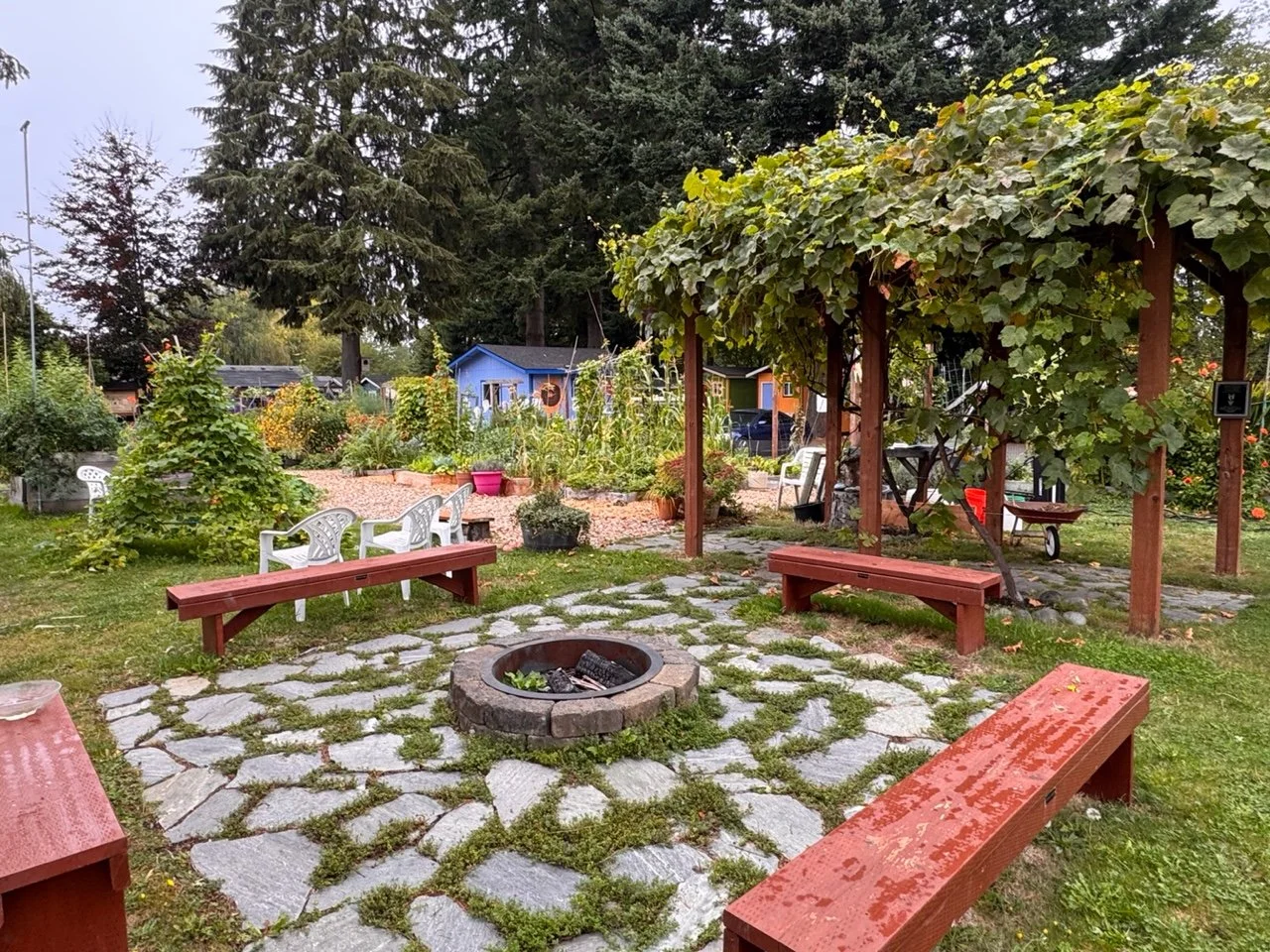
Before we dug in on Monday morning to get organized on fall fundraising for WIG, we walked over to see the community garden and tiny-home village at Westminster Presbyterian in Olympia. Would you nice walking stick for the five minute walk there!
Such a hidden treasure-you and your church might want to sell everything, and buy a field like this one. Such a precious pearl-you might want to scrap all your cherished accomplishments and belongings, and measure your life-if measure you must-by the life of a place like Hope Village and the “Garden of Weedin”.
Hope village is a tiny-home community hosted on the church’s property. From was I can see looking in as an outsider, the church has taken a cooperative but firm approach with the city and neighborhood in making room for this place and the people who live there. I think they have worked hard to create a process to help people lacking secure shelter find a place here. Of course, one would need to ask the residents directly about their experience, if they agreed to discuss the place.
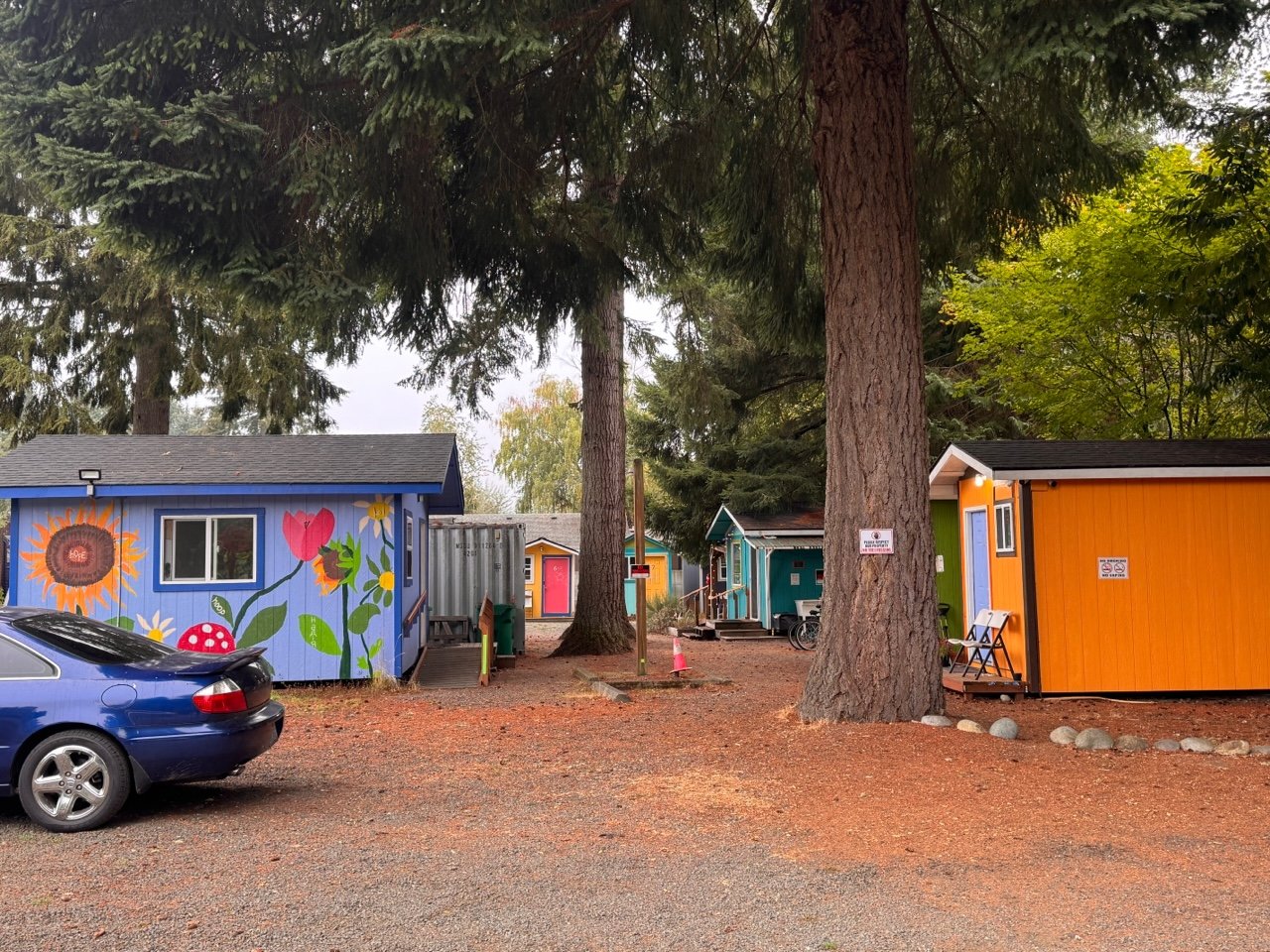
It also appears well-ordered, dignified, and beautified. It is visible but set back. The homes dwell in the shade of grand trees, such as douglas fir, big-leaf maple, western hemlock, and the largest pacific dogwood I have ever seen.
I would expect this has an ecological design benefit. The location under the trees helps moderate the temperature, providing a place of cool shelter on the bright sunny days of the summer (and a softening of the long rainy season.)
And I imagine that the shelter of the trees carries a deeper meaning, something less able to be spoken, something like the psalms evokes “the one who dwells in the shelter of the most high/abides in the shade of the almighty.” Sublime imagery of a divine presence marked by providing a terrain, a space of humble, safe-enough everyday dwelling.
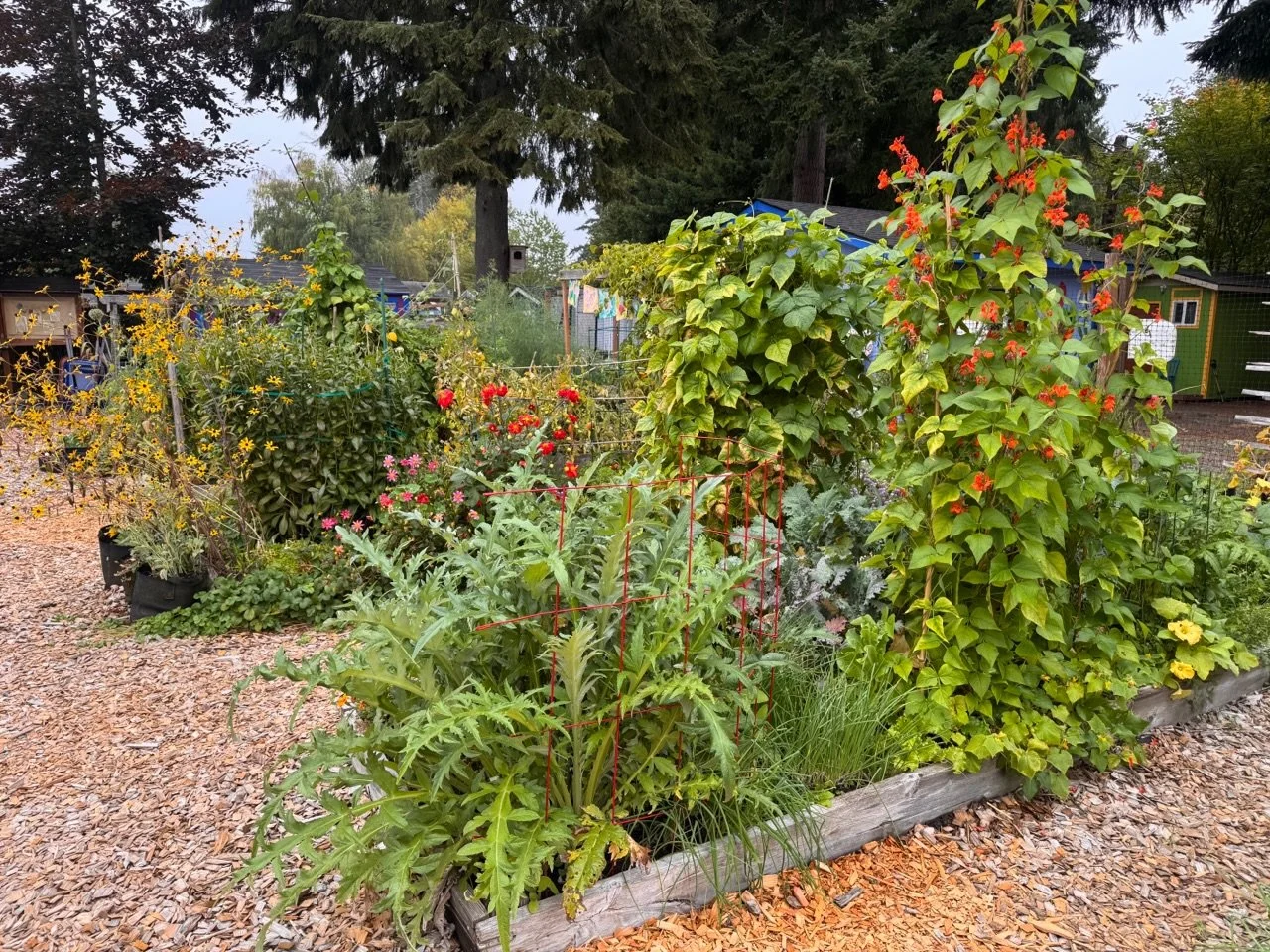
On that same terrain, in this shared space with the village we encounter and enter the ‘Garden of Weedin.’
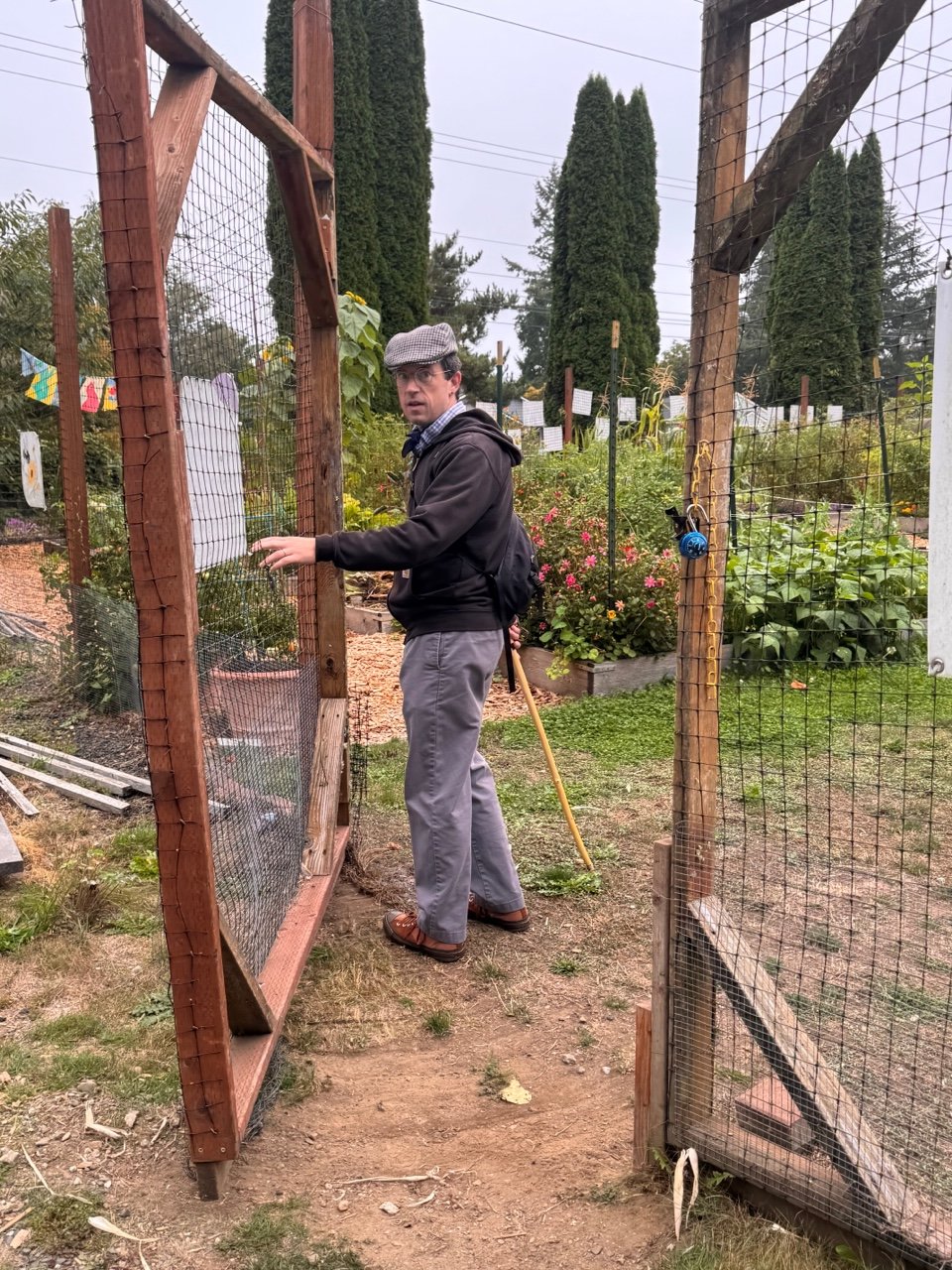
Here we are crossing through the gate to the inside, the sheltered garden. Not only is that like unto an image of Mary the mother of God, but it is also like a fundamental process of living systems, a distinction between self and environment. The fence keeps the herbivorous animals out of the food-gardens (the rabbits and black-tailed deer would love to sample these tender goodies, but suburban olympia provides them plenty of food!).
And it worth thinking about this fence, and rules for the gardening radicals, with reference to the Nobel laureate Elinor Ostrom’s work on community based governance systems. Among her ‘8 Rules for Governing a Commons’ is that a community define and maintain boundaries.
Who has access and how, on what terms? Related to that, What does each member receive, and what are they expected to give? A community project will not succeed as a community if it is governed in an authoritarian, personality-driven fashion. But a free-for-all, laissez-faire ethic will not succeed either. This tends to be another place where community-projects falter-a failure to define boundaries, authority, rules, responsibility. (And it needs to be understood in the face of the prevailing libertarian outlooks that say things like communities and states can’t govern collective resources, therefore just privatize them because the market will more wisely steward them, or regulation hampers construction, or laws and morals hamper the rule of might from just taking it all.) That can be done with in egalitarian fashion with a light handed touch of hierarchy-but you can’t get around this. This is how communities can build power, confidence, dignity, beauty, terrains of life and generativity...not to mention specifically housing and food!
Now a community also requires some elders, guides, and managers. They may help people do what they do just by their different ways of providing presence, reassurance, or clarity. And they probably also helps settle disputes, connect people, find resources, set a tone, ensure fidelity to agreements that serve purpose and life. I tend to think if you can have a couple people who can share such a role, that can be beneficial. It is a lot to expect of one person to do-and having a distribution of authority and an expectation of succession helps guard the community and work from being tightly held by the manager-helper, as well as protect the manager-helper from being mis-used by a community that isn’t ‘pulling their weight.’
And I this year I have really been grateful to benefit from being a part of a garden community. I have had a vegetable garden most of my life, but this past year, we had to unexpectedly move house, and found myself without a garden. After some due winter moping about this, I got in touch with Sue, the garden coordinator at WPC (we go to church their some, in part because it is walkable, in part because of the good spirit of the place.) I offered to help with tasks like weeding, repairs, odd jobs. She offered me a garden bed, as one had just come open! My wife and I gladly accepted-and for $60 a year, we’ve had access to a drip-irrigated 4x18 raised bed. We are expected to donate at least 10% of our harvest to the local food bank (gardeners gather on sunday mornings to harvest) and participate in 4 work-days a year. I missed one, and am making it up in other ways.
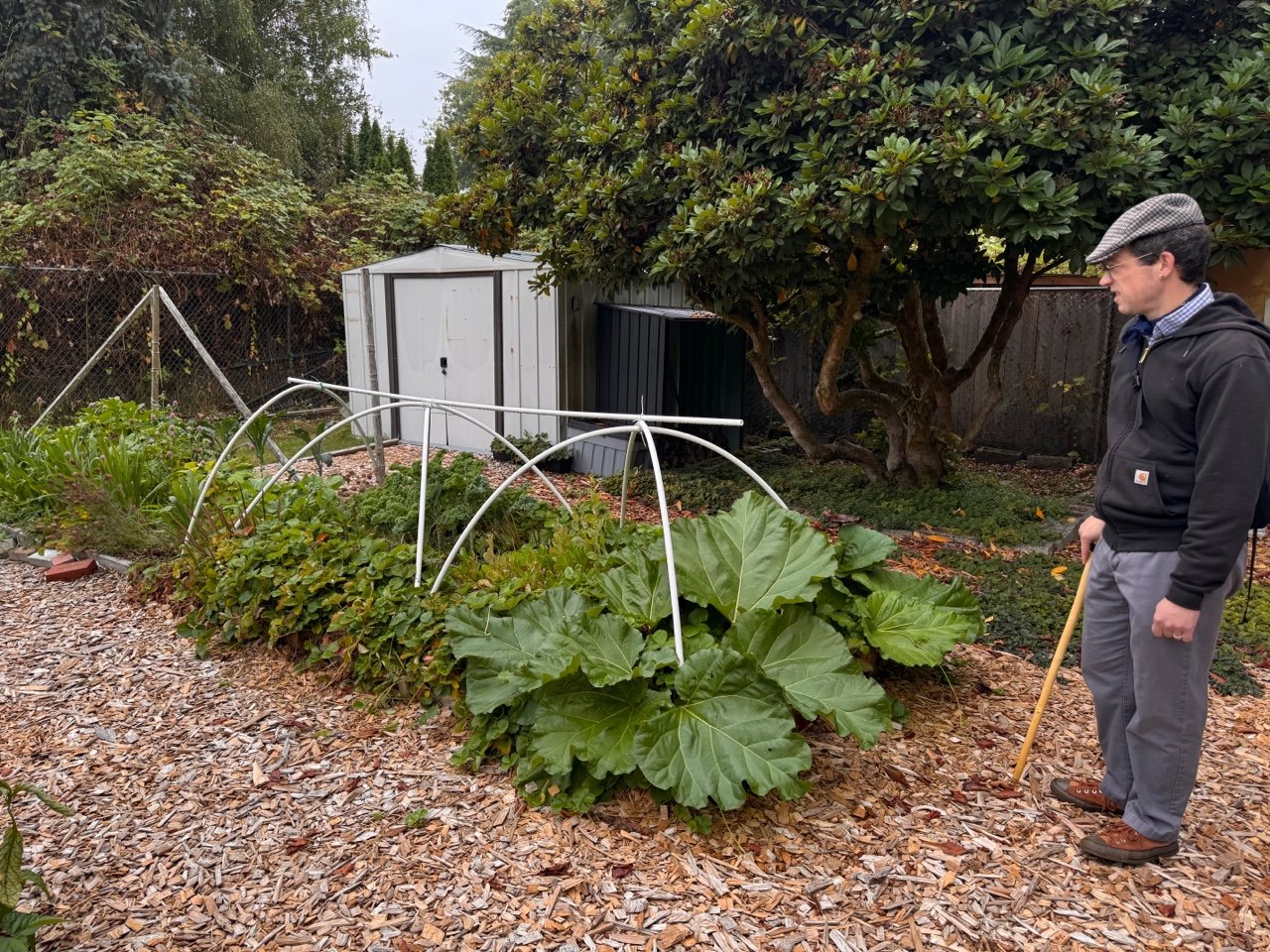
surveys shady garden: rhubarb, strawberries, kale, lettuce, salsify, squash, winter cover cropping up, and welcome weeds!
One day I noticed a large pile of construction waste near my house as I walked to the garden to tend and harvest. I’d been looking for 6 ft of 2x4 lumber to repair the produce washing table, and had even put something in the church newsletter, but nothing yet. So I immediately texted the builder, who had done some final repairs on our apartment. He welcomed me to take whatever I wanted from the waste-pile. So, the garden drew gifts from beyond it’s immediate circles. And I was able to use some wood that might have gone to the landfill toward a purpose of repair. It gave a few more years to the wash table, and it let me exercise a desire, a need within, to give in a way that might contribute to the conditions of life and work for the garden.
But I am so grateful for the garden. When we moved, my wife and I went to evening prayer in the garden, where we met some people from church, heard a talk about the music of trees, and prayed. Like that evening, I’m grateful to continue to be part of something like this garden, to be able to contribute, ...and loosen the hold of some learned habits/compulsions to need to make things happen. (Hi there pastors and helping professionals...among others!)
I like to go over there just to sit for a few minutes in quiet, to look around and take in sights of the garden and the larger place at this moment in the changes of seasons, to play around in the garden bed, draw and sketch, pray, say thank you to god.
I’m grateful to tend, harvest, eat and donate: onions, peas, squash, peppers, spinach, lettuce, rhubarb, strawberries, black salsify, red beets, kohlrabi, endive, purslane, lambs quarters, plantain, st johns wort, dandelions, volunteer nut trees-all from less than 80 sq ft of garden.
I show up Sunday morning and find a taste of the Spirit as I help a few others pick, wash and pack for the food bank, and also pausing to notice the beauty around us. I’m so grateful to have this place to show-up with others in a a quiet way that is both effective and welcome, and that feels truer to who I am, the work I am drawn to-things you come to know when you ‘let your life speak.’
In May I connected an Episcopal church up on the Kitsap Peninsula to the garden coordinator here, so that they could see an example of a community garden and habitat that might impress the with some models and inspirations of energy for their own intentions to build a place of life and community and nourishment fit for their place and neighborhood. It helped them to see that what they hoped to build with their neighbors in their own setting was possible.
One thing they and I am more aware of now are the many retired people in both places who would love to have a vegetable garden, but don’t have room for gardens in their apartments or mobile-home courts.
How can a church with a little land invite people into their vineyard?
How can you make a place,
where a community and its members realize a sense of life, nourishment beauty, repair, and giving back?
where they experience refuge, shelter, belonging, responsibility, truer freedom in this season of life?
where you find good work, truer vocation, and just being with God, others, the earth, yourself?
The work we hope to continue doing with Wild Indigo Guild of ‘designing restoration’ can help you discover examples of gardens, landscapes, and community projects that guide, inspire, energize and encourage you to not simply replicate or imitate them, but to discover the divine invitation for you, you community and your place to enter and work toward places of nourishment, quiet, life, repair, compassion, gratitude, beauty, justice, community.