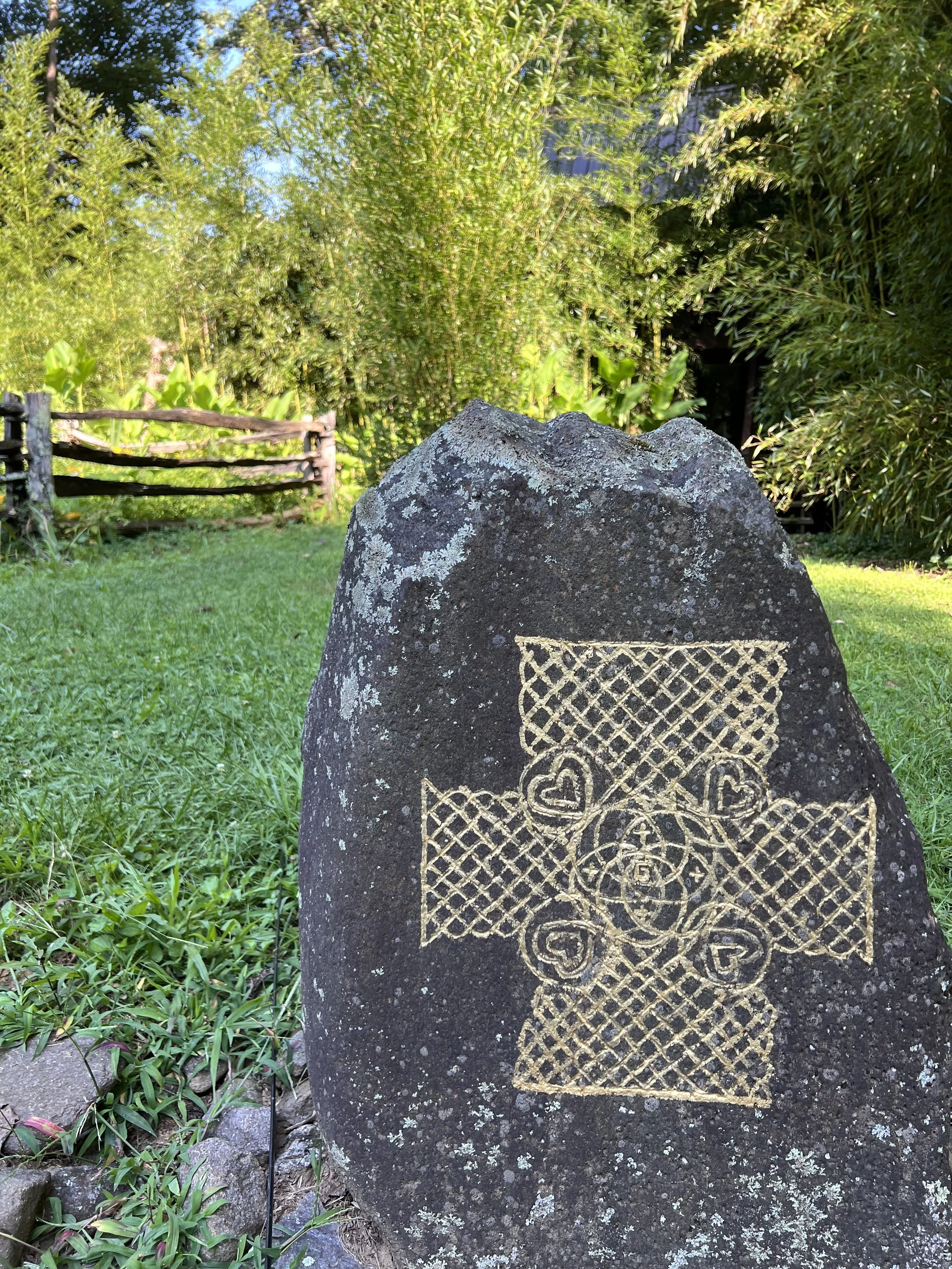
Sit Spot in the Graveyard

Weeping Willow by Evan Clendenin
Along with younger folks at Beulah Presbyterian church we stepped closer toward the underside of life and green growth this summer. We tried to more fully appreciate the place that death and decay, disturbing as these can be, in the created ecologies God brings forth.
John brought materials for making worm-composting bins one Wednesday. The bins house red worms (Eisenia fetida), which eat, and thereby transform, kitchen scraps and other organic materials into rich soil-makings. The worms help recycle and transform waste and waste-making habits. The ‘worm castings’ contribute nutrients, humus compounds, hormones and enzymes, bacteria, and other mysterious stuff that can aid soil and plant life.
These younger folks stepped right in. They did not complain ‘gross!’ They dirtied their hands making bins. A few of them talked with their parents about bringing home a bin for their household composting. Some of them already had worm-bins at home. They were curious and at ease with looking at these processes of decomposition and decay, and assisting the worms, who do much of the decay work in the creaturely economy.
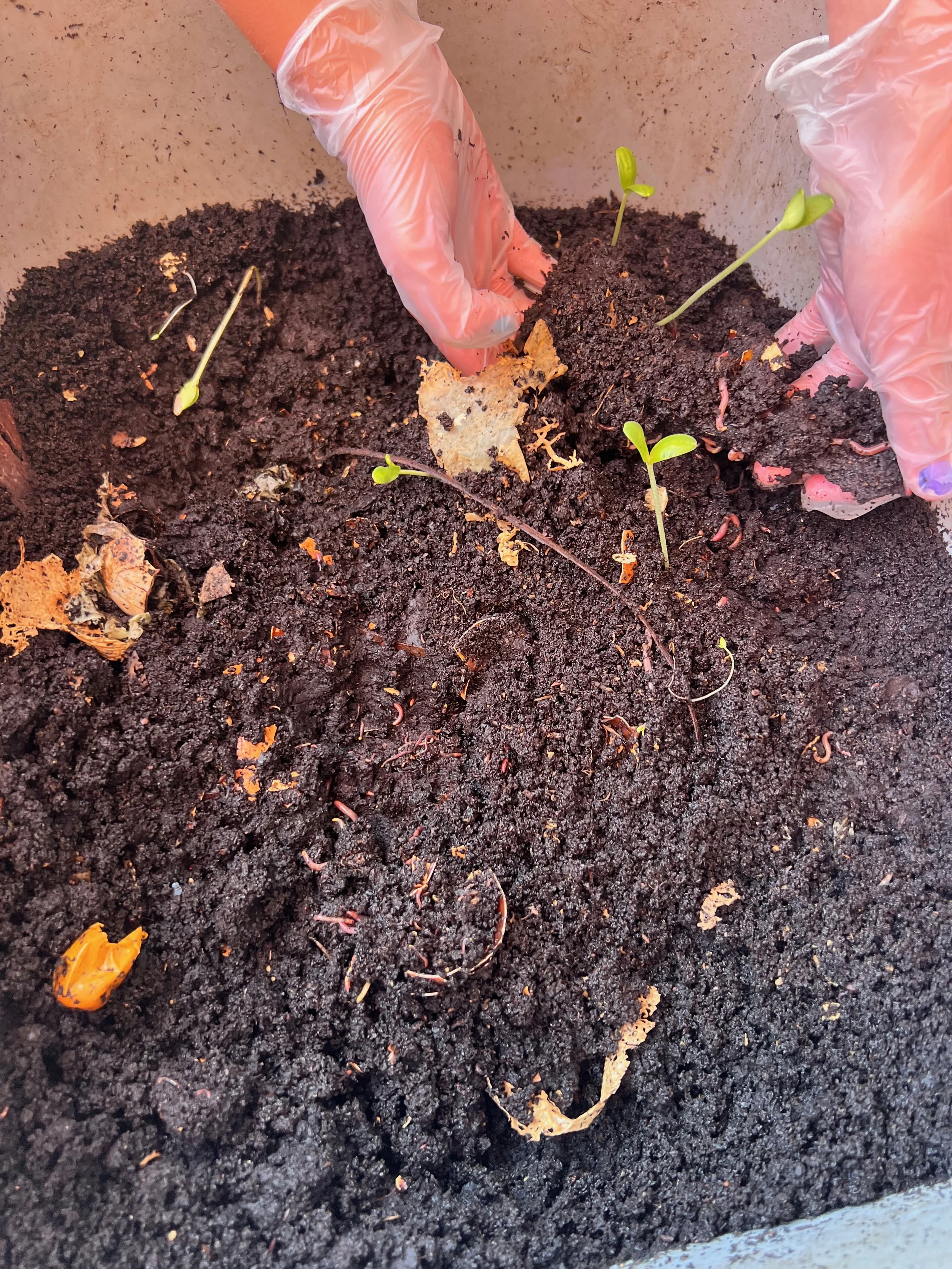
Youth at Beulah moving worms from our bin to their new one.
We also invited them this summer, like we invite all Wild Indigo Guilds, to find a sit spot. The sit spot furnishes a foundational practice for both our 8 week formation series, and stepping into ongoing contemplative engagement with earth-tending and Spirit.
We invite you to find a place relatively near you, where you pause, and dwell with the place, paying attention to God with the place and with you there. A sit spot can be a place you return to over and over. A sit spot finds you.
What in a place calls out to your spirit to stay a while?

What called out to them was the cemetery. They stayed a while in that hallowed patch of the first presbyterian congregation in what we now call western pennsylvania. They said they felt peaceful as they sat, writing, drawing, looking around.
Later, John showed them how to take charcoal rubbings off of the old stones. They spoke with startlingly mature insight, appreciation and clarity about death and decay as part of the created order, wondering about the people’s lives, and the meaning of that place among the church grounds.
These younger folks stepped right into that place. They aid us and others to pay attention to such places on the church grounds and elsewhere where land is tended for the deposition of the bodies of the dead and their remembrance among us.
We might wonder with them at God’s presence and working in this place where the dead rest, and their place in our spiritual practice of life, death and resurrection.
We would follow their example in such a ‘long, loving look at the real’ against forces that keep us from seeing in this way. We’re captive to the ‘american way of death’ (as written about by Jessica Mitford) and the burial grounds it fabricates. Broad expanses of mown, irrigated turfgrass kept greenish by an embalming fluid of insecticide, herbicide and synthetic nitrogren fertilizer incarnate a kind of undead ecology. Concrete boxes keep the thought far away that a children’s rhyme so humorously brings near,
The worms crawl in,
the worms crawl out
The worms play pinochle
on your snout!
That undead landscape wants to keep trees out. Messy apples attract ‘bees’. And leaves fall. What would happen if someone visiting a grave were struck by a falling leaf! They might be suddenly graced with a moment of contemplation… a grave intrusion.
My wife and I like to stop by and walk a little pioneer graveyard near home, settled down beyond view of the expanding olympia suburbs. The old stones, with weathered names, bits of scripture, and chipped symbols, stand amidst massive firs and aged fruit trees. In the autumn we find pink blush crab apples, and tiny sweet pears. American chestnuts grow where squirrels plant nuts from two large specimens planted nearby 150 years ago.
And garry oaks, the native white oak of western washington, still grace this hallowed ground. The Nisqually, Squaxin, Cowlitz and Chehalis peoples of the south salish sea region continue to collect garry oak acorns, and tend camas lilly patches, that once were part of an extensive agro-ecological landscape based on this cascadian oak savannah. And in little patches, even a fading pioneer cemetery, such fragments and refugia hang on.
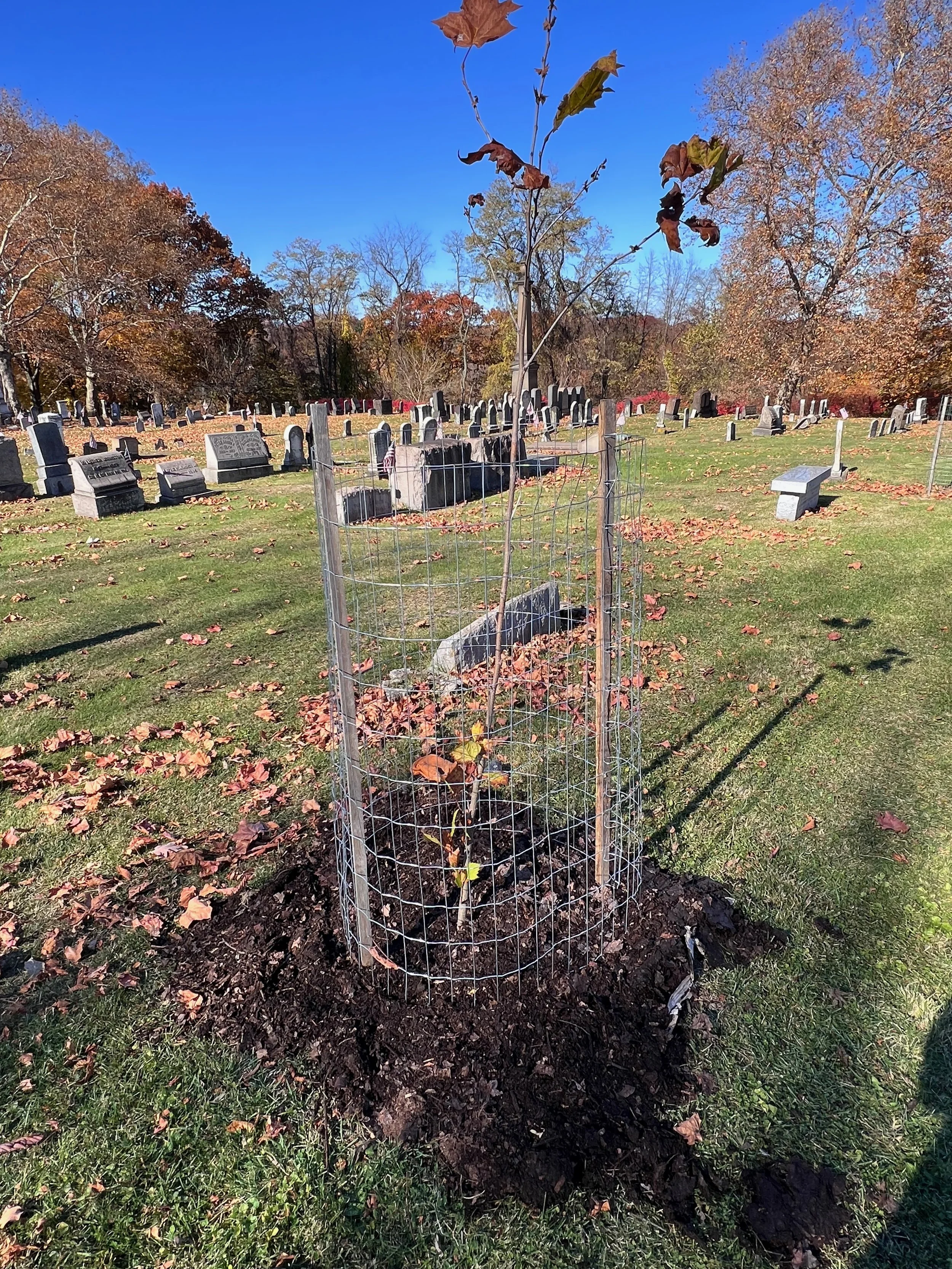
A tree planted in the cemetery of Beulah Church
What do you notice in the cemeteries and other burial grounds near you?
In what ways might you, your community, your church, see and tend these places?
What steps might you take to incarnate a more humane, humble and interconnected earthly habitat in such places and beyond?
Summer of Action
We’ve been busy this summer putting our plans into action!
We’ve been quiet on the website and blog for a few months, not because we haven’t had anything to write, but because we’ve been so busy actually doing the work we’ve planned for so long! Here are a few snippets of our work in May, June and July.
Our Second Guild: Westminster Presbyterian Church
Back in April we began a “guild” at Westminster Presbyterian Church of Greensburg. Guilds are small groups within larger congregations who learn, pray and work together to come to a greater appreciation of God in nature and our call from God to care for the earth . Together we worked through the eight weeks of the first phase of the Wild Indigo Guild program. It was so wonderful to get to know a group of people and learn with them about God’s call to care for the earth and care for our communities. Together the group of about 10 people began to discern some specific ideas for their multi acre site as we realized the potential for food production and ecological restoration. On our last day of the first phase we planted a swamp white oak at the church, a tree that I grew from seed. It was a powerful experience to get this little tree into the soil of its new landscape. Evan and I are excited to continue to work with Westminster to develop more concrete plans for action in Phase 2 of our guild program.
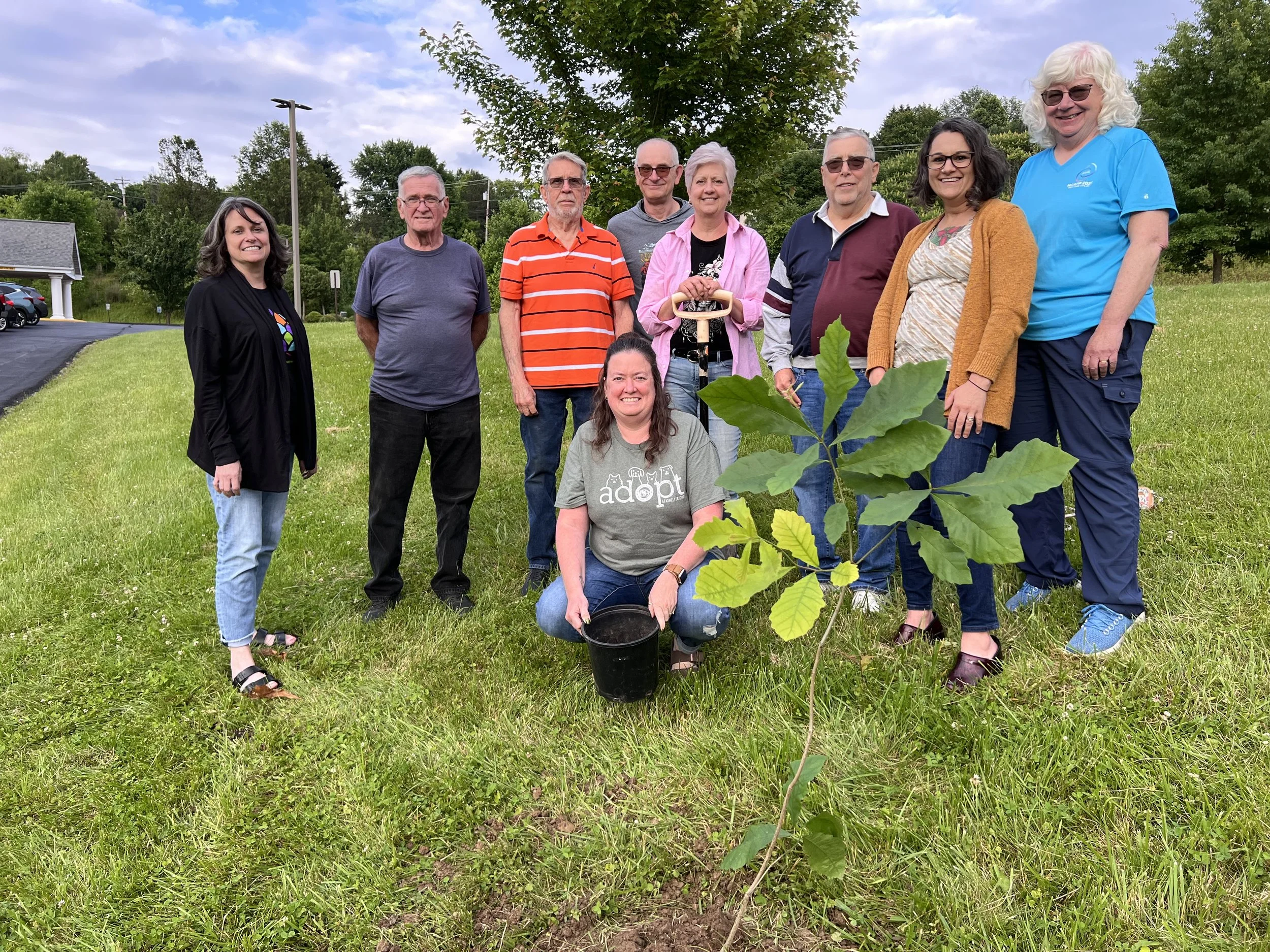
Our Guild from Westminster Pres and their new Swamp White Oak.
Summer Institute of Pittsburgh Seminary
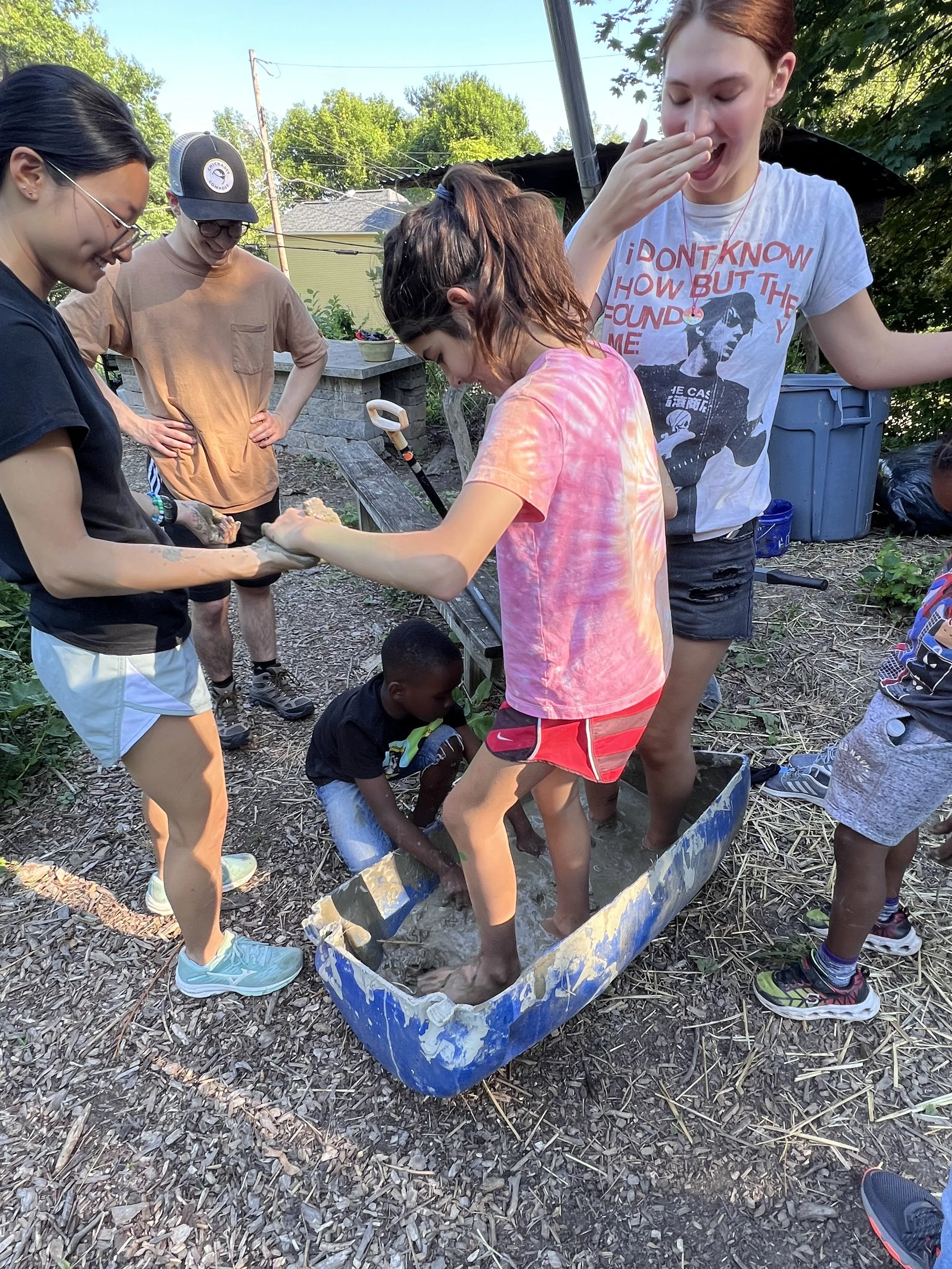
Also in June we began a six week program with Pittsburgh Theological Seminary’s Summer Institute for college students. The focus of the program was on eco-theology and social justice, specifically climate and environmental justice. Together we worked at Garfield Community Farm, dove into permaculture design and even built a portion of a cordwood and cob wall! These students were amazing and gave me hope that the young generation of adults are not giving up but leading the way toward a sustainable future. We’re so grateful for this opportunity to hone our teaching skills with young adults and to work with amazing workshop leaders from around the country.
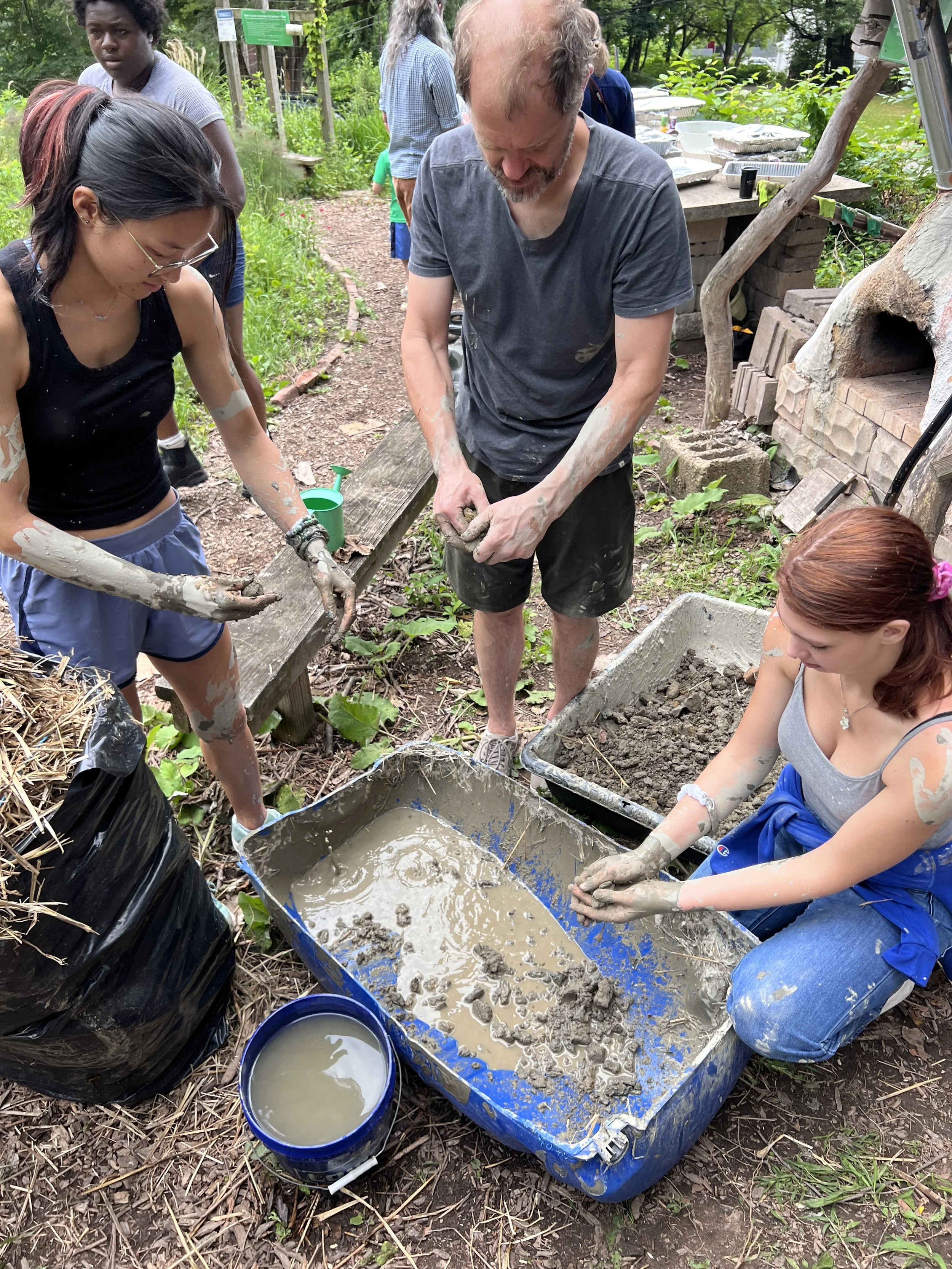
Working with clay, sand and straw to make cob, an ancient and effective natural building material.
East End Youth Ministry
Also in June, Evan and I began work with East End Youth Ministry and our friend Alex Ruzanic. This opportunity has already been a lot of fun and a great learning experience for us both. We’re learning how to make our curriculum adapt for students in sixth through twelfth grade - not always an easy task! We were delighted when we showed up at Beulah Presbyterian Church, the home of EEYM, and found a turkey hanging out by the entrance! We quickly learned that the turkey had already been named by the campers and had become a beloved mascot! Jeffery the turkey has turned into a great learning tool for us as we’ve worked to understand how the myriad of living creatures in any ecosystem support one another and provide for each other’s needs. This drawing was our “niche analysis” for Jeffery and his many neighbors.
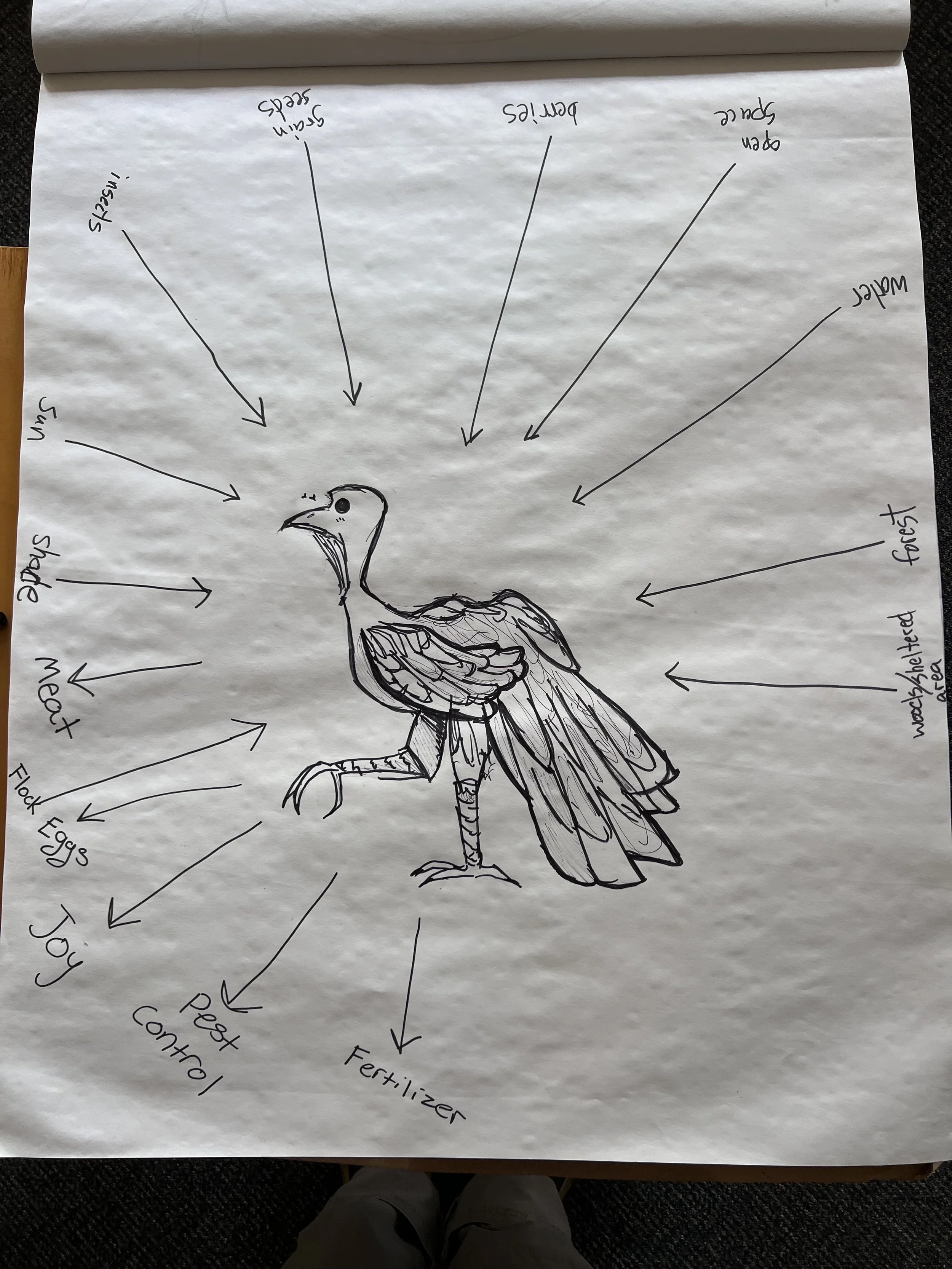
Jeffery the turkey! Drawn by a student of EEYM. Together we figured out the ecological and farm niche for Jeffery.
Yesterday Evan and I met to discuss the future and our plans to expand our work. We so believe that now is the time for people of faith to connect with God through nature and develop realistic plan for ecological restoration and climate action. We’re ever grateful to The Open Door Church for helping us launch this important work. We’re also grateful to those who have already donated to make this work happen. Our world is heating rapidly now and its our job, as followers of Jesus, to do what we can to show our communities what it can look like to care for land, people and our more-than-human neighbors. This fall we’ll be hosting a few fundraising opportunities, at least one book group and at least two more guilds. We hope you can join us soon!
And, please consider a donation to help us make this work as affordable as possible for any group and church.
Dancing in the Wind
During week two of our Guild at Westminster Presbyterian Church Caryl shared this poem with us that she wrote during time in her “sit-spot.”
The tall, majestic oaks and poplars sway to the rhythm of the wind.
Some like the pear jump all in like the hokey-pokey.
Others twitter their leaves keeping time to the music.
Some pairs are intertwined, swaying like Fred and Ginger.
As the music of the breeze gets louder, the branches sway ‘til you wonder why they don’t break.
But they are built for this. Bending, dancing, gracefully touching the sky.
There is a peace in the dance. A soothing of the soul.
Tilted skyward the dance is mesmerizing. It fills the heart.
The trees need the wind to scatter seeds, to clear out dead branches and leaves.
Does the wind need the trees?
They certainly change the wind. Bouncing around and slowing down.
But there would be wind without the trees.
Caryl Fish, April 2024
Garfield Community Farm’s Land Acknowledgment
Pittsburgh’s hills and river basins have always been the land of ecological and cultural convergence. Here we find ecological systems meeting from the mountains in the east, the grasslands to our west and northern forests and lakes in the north and the broad leaf forest to our south. It has also been a land where people converge.
Garfield Community Farm exists on three city blocks where thirty homes once stood. A neighborhood of working class Irish, English and Italian immigrants gardened these spaces, tended a community orchard and lived in homes on this land. Later African immigrants from the Southern states made the Garfield hill their new home bringing new foods and culture on their journey north. But this land, these hills and river basins that we call Western Pennsylvania were a land of converging cultures far earlier than the 1900’s.
Pittsburgh’s rolling hills, hundreds of streams and rivers running toward the convergence of the great three rivers, seems to have always been a land of cultural convergence. For thousands of years our land was a shared area of converging indigenous people. Few tribes or nations call these hills their ancestral home, but many cultures met on these hills because of these three rivers.
About 12,000 B.C. at the Meadowcroft Rockshelter and Historic Village in Washington County some of the earliest known people in our part of the country lived and called the hills of western PA home. The Osage people call the Ohio River basin their origin as a people, later migrating west and south through the Mississippi River Basin. Later the Adena people arrived, then the Hopewell and Monongahela. During colonial invasion in the east nations again converged with the rivers finding a land of plenty. The Susquehannock and The Delaware peoples came from eastern Pennsylvania, Shawnees arrived from the south and Iroquoian people migrated from New York state. Because the area wasn’t the ancestral homeland for many of these nations, their cultures often mixed like the Allegheny and Monongahela Rivers.
For a few decades the three acres that are now Garfield Community Farm, sat vacant, houses gone and foundations of homes filled in with rubble. Today Garfield Community Farm is a place where people meet, mix with one another and natural systems and leave these acres of land better for it. Our land was the shared land of many peoples before it became what it is today. We can only strive to honor the indigenous people and all those who lived here before us by caring for our land well, using it to care for one another well, and to leave this land for future generations to tend and reap its bounty. Today, we at Garfield Community Farm strive to continue to honor indigenous first nations by hearing their stories, learning how they live today and by understanding the continued quest for land and food sovereignty in 21st century. We seek to honor our current neighbors who have rich family histories, connections to land, and much to teach us in our quest to care for the earth, care for one another and do it with equity and justice.
The Wolf Tree and a Lament for Creation
As a child, the woods behind my house was a magical place, where mysterious animals roamed and trails extended to the northern boreal forests of Canada. Little did I know the twenty or so acres of woods actually ended at the cul-de-sac at the other end of the neighborhood.
By John Creasy
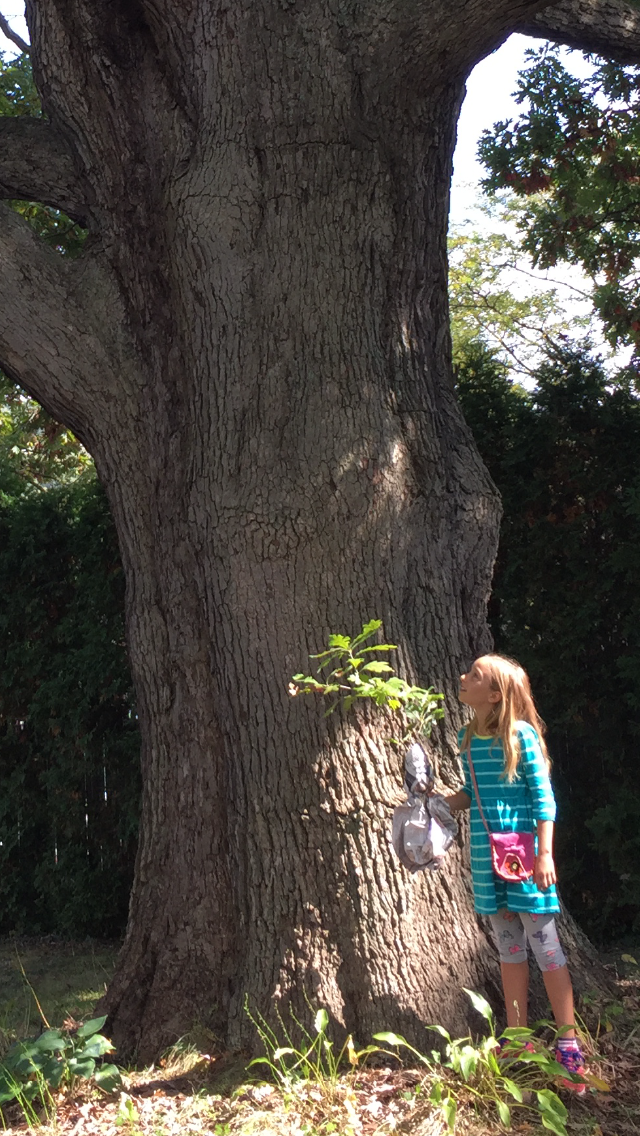
A giant White Oak and one of it’s little babies. One of my “babies” too.
As a child, the woods behind my house was a magical place, where mysterious animals roamed and trails extended to the northern boreal forests of Canada. Little did I know the twenty or so acres of woods actually ended at the cul-de-sac at the other end of the neighborhood. My imagination and my woods shaped me in significant ways in those early years. Hours spent in the little patch of wilderness helped me connect with God, with my family and with all the nature around me.
As a little kid we hiked around the woods as a family, our German Shepherd running laps around us as we splashed through the mud. Later I bought a mountain bike and would ride the trails, the woods seemed a lot smaller then, but they were still significant for the suburbs of Pittsburgh. I learned that the woods, the old barn in the middle and the big old house were all part of Bush Nurseries, a local nursery business that had closed down in the early 1980’s. Now, the land was being sold to a developer.
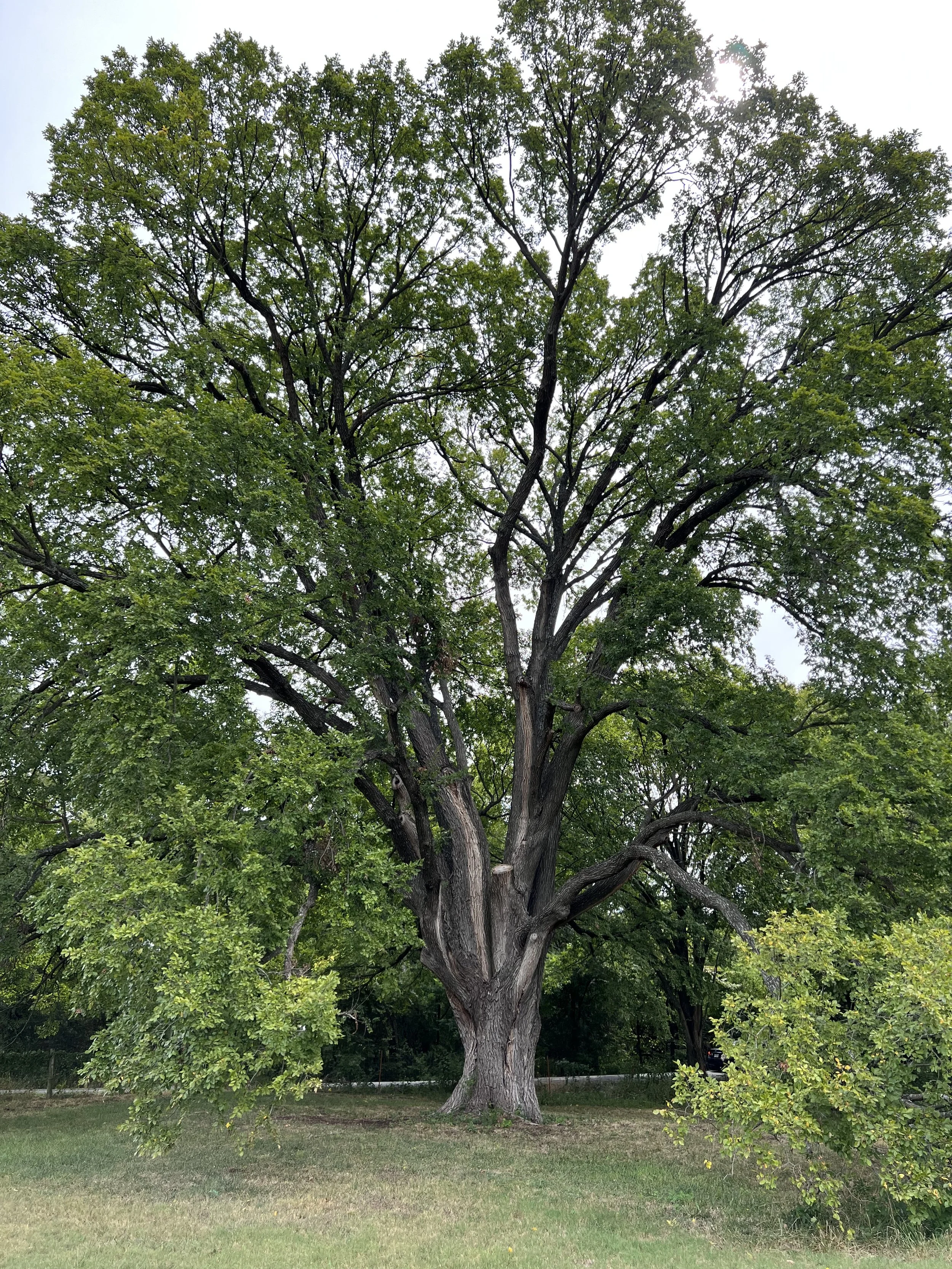
Early in life I connected in some meaningful but unexplainable way with oak trees. I just liked them, I like the way their sprawling lower branches could reach far away from the trunk, twisting and turning toward the light. I liked their huge trunks and appearance of great age. There was one oak in on the edge of the main tree nursery that had grown for decades into what is known as a “wolf tree,” a tree that grows horizontally large to wolf up all the sunlight. I would sit under those sprawling branches, against the rough bark of that big tree. It felt like home. In reflection back, it was a first sit spot for me, a spot to just be and relate to the birds, deer, plants and other animals of that spot. That big old wolf tree was special to me… and I knew it was going to be cut down.

The largest Elm tree in Texas and a great example of a “Wolf Tree” at the edge of a farm’s forested edge.
I’ve told this story before, because I think it’s funny, because the events could have gotten me into a lot of trouble, because people listen and laugh when I tell it. But this story sticks in my mind because it was the first time I felt significant lament and grief for creation.
As the developers began staking out the the roadways and properties throughout the woods I became adamant that I would climb the old wolf tree so they couldn’t cut it down. This was before Luna climbed her giant Redwood tree in California. I’d never heard of an eco-activist. But I felt a need to save my big tree. As the months went on more and more wooden stakes with pink flags on top were popping up all over the woods demarcating the spots where boundaries would be. My woods were no longer mine, it felt like a violation. My woods were going to all be cut down, not just the big old wolf tree.
One day, I grabbed hold of one of those wooden stakes. I pulled hard on it and it came up out of the ground. I stood there holding that flimsy wooden stake. I wondered where the tree came from that made that stake now marking where more trees would be cut down. Another stake was just a few feet away. I pulled that one up too. Then another and another. There were so many and they were so easy to pull up! I started moving them, putting them in different locations. Some of them I took home and hid in my family’s garage. Some of the bigger stakes were made of 2x4’s, I figured they marked property corners. I moved those ones too.
Fast-forward a few years and I had a good friend living in a brand new big house in the middle of what was once my woods. Two things surprised me when I talked to Pete about the loss of that landscape. He too felt grief and lamented the continued removal of the forest. Pete saw the remaining woods and saw the trucks hauling out logs. He connected with the land and trees very quickly and even shed tears when his big tree was cut down, a huge Eastern White Pine. I was also surprised when he told me that his neighbors were in a dispute about their property lines. The maps didn’t match up. One day I showed Pete the old stakes in my garage. He quickly realized what I’d done. We both felt kinda good about it.
I recently learned a new word: Kithship. “Where kin are relations of kind, kith is relationship based on knowledge of place—the close landscape, “one’s square mile,” as Griffiths writes, where each tree and neighbor and robin and fox and stone is known, not by map or guide but by heart. Kith is intimacy with a place, its landmarks, its fragrance, the habits of its wildlings.” so says Lyanda Lynn Haupt, in Rooted: Life at the Crossroads of Science, Nature, and Spirit.
My response to grief probably wasn’t the right response. But, as a child with deep connections to a piece of land, a true kithship to the plants, trees and animals of a landscape, what else should we expect. My land was threatened and I felt a need to do something about it, I had very little I could do.
Today, any child with any care or connection to nature is continually in a state of lament. How can we, as adult, turn away from the losses we are collectively experiencing? How can we not do all that we can do to love the earth, care for creation, reject destructive cultural norms, etc? Loss, lament and grief can lead to sustained commitments when experienced in a supportive community. Today, through Wild Indigo Guilds, we’re working to create those kinds of communities. Communities that lament together and develop meaningful action for the earth, for God’s people and for our children and their children.
For info on joining a Wild Indigo Guild visit https://www.wild-indigo-guild.com/wild-indigo-guilds